Supplier Relationship Negotiation: Building Partnerships That Drive Value

In the fast-paced automotive industry, Toyota’s procurement team faced a critical crossroads. A key supplier of advanced electronic components was at risk of being replaced due to rising costs and quality concerns. However, rather than opting for a traditional adversarial negotiation focused solely on price, Toyota’s procurement leaders engaged the supplier in a deep, collaborative dialogue. By applying sophisticated supplier relationship negotiation tactics grounded in strategic sourcing frameworks and total cost of ownership (TCO) analysis, Toyota transformed a potentially transactional supplier relationship into a long-term innovation partnership. This shift not only secured supply stability but also unlocked joint cost savings and accelerated product development cycles, illustrating the immense strategic value of supplier relationship negotiation.
Supplier relationship negotiation is no longer about just squeezing prices. It’s a strategic discipline that blends negotiation skill, category management, value engineering, and behavioral psychology to create win-win partnerships. These partnerships drive continuous improvement, mitigate risks, and foster innovation. In complex supply chains – from Boeing’s aerospace components to NHS procurement of medical supplies – mastering supplier relationship negotiation is fundamental to achieving competitive advantage and operational excellence.
This comprehensive guide will equip procurement managers, category managers, CPOs, and sales directors with a deep understanding of the strategic foundations, key negotiation frameworks like the Kraljic Matrix and BATNA/ZOPA analysis, and actionable step-by-step processes. You will also gain insights from real-world case studies, advanced negotiation tactics, and ready-to-use scripts designed to elevate your supplier relationships and deliver measurable value.
· Table of Contents
· The Strategic Foundation: Frameworks, Psychology, and Research
· Key Frameworks and Models for Supplier Negotiation
· Step-by-Step Supplier Relationship Negotiation Process
· Real-World Case Studies: Lessons from Industry Leaders
· Tactics and Counter-Tactics in Supplier Negotiations
· Advanced Strategies for Expert Negotiators
· Scripts and Templates for Effective Supplier Dialogues
· Frequently Asked Questions on Supplier Relationship Negotiation
· Conclusion and Next Steps
· References and Further Reading
The Strategic Foundation - Frameworks, Models, Psychology with Named Research
Supplier relationship negotiation is rooted in strategic procurement thinking that balances power dynamics, risk, and value creation. The seminal research of Peter Kraljic (1983) introduced the Kraljic Portfolio Purchasing Model, which categorizes suppliers based on supply risk and profit impact to prioritize negotiation focus. This framework shifted procurement from tactical purchasing to strategic sourcing, emphasizing the importance of supplier segmentation and tailored negotiation approaches.
Moreover, behavioral economics and negotiation psychology play pivotal roles. Research by Harvard’s Deepak Malhotra demonstrates how understanding cognitive biases, framing effects, and emotional intelligence can transform negotiation outcomes. Integrating these insights with Porter’s Five Forces analysis helps procurement professionals assess supplier power, competitive rivalry, and threats of substitution, informing negotiation strategies that align with broader market dynamics.
Total Cost of Ownership (TCO) and should-cost modeling frameworks further ground supplier negotiation in data-driven value analysis. By quantifying not just price but quality, service, logistics, and innovation contributions, procurement teams build compelling cases to justify partnership investments or cost improvement initiatives. This holistic approach supports lean procurement and value engineering efforts, fostering supplier collaboration beyond price haggling.
The strategic foundation of supplier relationship negotiation thus integrates category management, supplier segmentation, economic and psychological models, and operational metrics to build partnerships that drive sustainable value.
Key Frameworks and Models
This section explores three essential frameworks that underpin effective supplier relationship negotiation:
1. Kraljic Portfolio Purchasing Model
2. BATNA and ZOPA (Negotiation Zone)
3. Supplier Segmentation Matrix
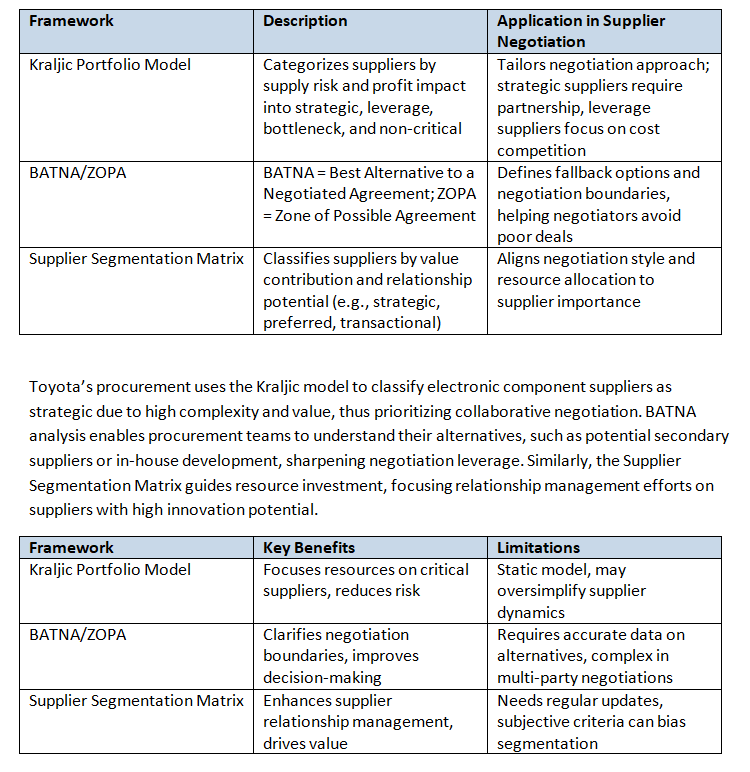
Understanding and integrating these frameworks enables procurement professionals to approach supplier negotiation strategically rather than tactically, aligning negotiation tactics with supplier importance and market conditions.
Step-by-Step Process
Step 1: Preparation and Data Gathering
Effective supplier negotiation begins with rigorous preparation. Collect and analyze data on supplier performance, market pricing, TCO, and internal demand forecasts. Use should-cost modeling to estimate a fair price benchmark. Apply Porter’s Five Forces to assess supplier market power and competitive threats.
Recommended script for internal alignment:
“Based on our spend analytics and supplier risk assessment, we consider Supplier X a strategic partner. We’ve identified opportunities to reduce cost by 8% through joint value engineering initiatives. Our BATNA includes two secondary suppliers with 10% higher costs but faster delivery.”
Step 2: Define Objectives and Develop BATNA
Set clear objectives aligned with category strategy: cost reduction, quality improvement, innovation collaboration, or risk mitigation. Develop your BATNA to understand your fallback if negotiations fail. This strengthens your position and prevents conceding unnecessary value.
Example objective statement:
“Our goal is to reduce total cost by 5% while maintaining current quality standards and improving lead time by 10%. If Supplier X cannot meet these targets, we will consider transitioning 30% volume to alternate suppliers.”
Step 3: Stakeholder Engagement and Internal Consensus
Engage cross-functional stakeholders (engineering, quality, finance) to ensure alignment on negotiation goals and constraints. Prepare a negotiation team with defined roles: lead negotiator, technical expert, finance analyst.
Internal briefing language:
“Engineering confirms no change in specs is possible; finance requires cost savings to meet budget targets; quality expects zero defect rate. Our negotiation approach will balance these priorities.”
Step 4: Initial Supplier Meeting - Relationship Building
Begin negotiations by establishing rapport and emphasizing partnership. Use open-ended questions to understand supplier challenges and priorities.
Suggested opening script:
“We value our long-term collaboration and want to explore how we can jointly improve cost and supply reliability. Could you share your current challenges and any improvement ideas?”
Step 5: Present Data-Driven Proposals and Explore Options
Present your analysis transparently, referencing should-cost estimates and market benchmarks. Invite supplier input on cost drivers and possibilities for value engineering or process improvements.
Collaborative dialogue example:
“Our analysis shows material costs account for 60% of price. Are there design adjustments or alternative materials that can help reduce costs? What support do you need to achieve these improvements?”
Step 6: Negotiation and Agreement on Terms
Use integrative negotiation tactics, aiming for win-win outcomes. Be prepared with concession strategies and counter-tactics. Formalize agreements with clear KPIs and continuous improvement commitments.
Closing script:
“We appreciate your flexibility on pricing and commitment to quality. Let’s document our agreement outlining cost targets, lead times, and quarterly performance reviews.”
Step 7: Post-Negotiation Review and Relationship Management
After agreement, monitor performance against KPIs. Maintain frequent communication to address issues proactively and identify further value opportunities. Implement supplier scorecards and joint business plans.
Follow-up communication:
“Thank you for your partnership in achieving our targets. We propose regular monthly reviews to track progress and discuss continuous improvement.”
Real-World Case Studies
Case Study 1: Boeing’s Supplier Collaboration in the 787 Dreamliner Program
Boeing adopted an advanced supplier relationship negotiation approach during the 787 Dreamliner development by integrating suppliers early in the design and engineering process. Instead of adversarial price negotiations, Boeing focused on joint innovation and risk-sharing agreements. This approach reduced production costs and accelerated time-to-market despite complex global supply chains.
Lesson: Early collaboration and shared risk models can transform supplier negotiations from transactional to strategic partnerships that drive innovation.
Case Study 2: NHS Procurement and Supplier Partnership for Medical Equipment
The UK’s National Health Service (NHS) employs strategic sourcing frameworks and supplier segmentation to manage critical medical equipment suppliers. By applying the Kraljic model and robust BATNA analysis, NHS procurement balances cost control with supply continuity during crises like the COVID-19 pandemic. Collaborative contracts with key suppliers include clauses for surge capacity and innovation funding.
Lesson: In high-risk, mission-critical categories, strategic negotiation focuses on resilience and partnership rather than cost alone.
Case Study 3: Apple’s Supplier Relationship Management for Component Sourcing
Apple’s procurement teams use should-cost modeling and supplier segmentation to negotiate with key suppliers such as Foxconn. The negotiation process emphasizes mutual investment in technology development and rigorous quality standards. Apple often shares forecasts and market intelligence to enable suppliers to optimize operations.
Lesson: Transparent information sharing and long-term commitment enhance supplier trust and drive superior value.
Tactics and Counter-Tactics
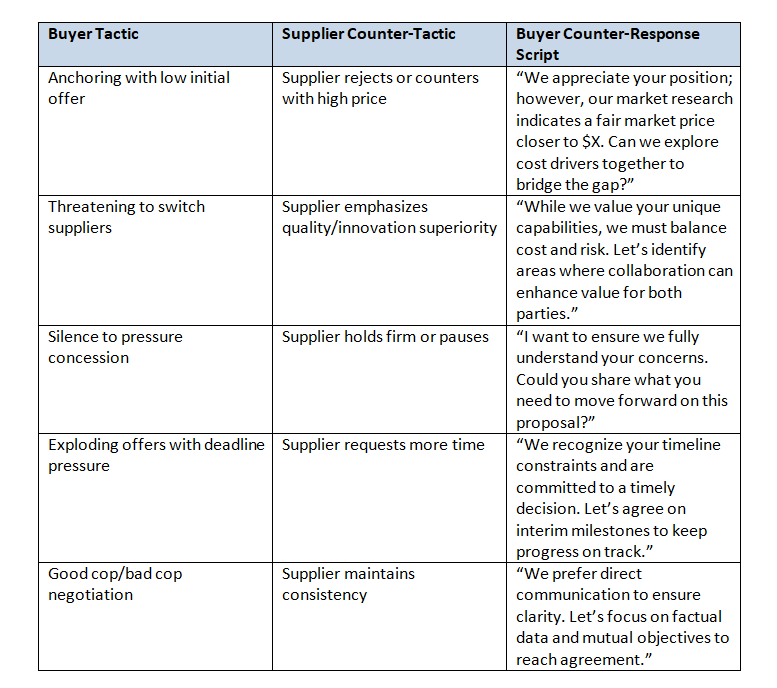
Understanding these tactics and scripted counter-responses helps buyers maintain control and foster constructive dialogue.
Advanced Strategies
For expert negotiators, advanced supplier relationship negotiation strategies include:
- Multi-Attribute Utility Analysis: Quantify trade-offs between price, quality, delivery, and innovation to optimize negotiation outcomes.
- Collaborative Value Engineering Workshops: Co-create solutions with suppliers to reduce cost and improve product design.
- Dynamic Contracting: Use flexible contracts with incentive clauses tied to performance metrics and innovation milestones.
- Leveraging Digital Procurement Tools: Utilize AI-driven spend analytics and supplier risk monitoring to anticipate negotiation opportunities and threats.
- Cross-Industry Benchmarking: Compare supplier terms and innovations across industries to identify best practices.
These strategies require sophisticated data analytics and mature supplier relationship management capabilities but yield significant competitive advantage.
Scripts and Templates
1. Initial Supplier Meeting Opener:
“Thank you for meeting today. We value our partnership and want to explore opportunities to enhance value for both parties. Could you share any challenges or improvement ideas from your perspective?”
2. Cost Reduction Proposal Introduction:
“Our analysis indicates potential cost savings in material sourcing and process efficiency. We’d like to collaborate on value engineering initiatives that can benefit both our organizations.”
3. Handling Supplier Pushback on Price Reductions:
“We understand the pressures you face. However, our market analysis shows that our target pricing is achievable. Let’s work together to identify areas to optimize costs without compromising quality.”
4. Closing and Agreement Confirmation:
“We appreciate your cooperation and commitment. Let’s document the agreed terms including pricing, delivery schedules, and performance KPIs, and schedule regular reviews to ensure ongoing success.”
5. Post-Negotiation Follow-Up Email:
“Dear [Supplier Name], Thank you for your partnership during recent negotiations. We look forward to working together to achieve our shared targets and enhance our relationship. Please find attached the signed agreement and next steps.”
Frequently Asked Questions
Q1: How do I determine which negotiation framework to apply for different suppliers?
A1: Use the Kraljic Portfolio Model to segment suppliers by supply risk and profit impact. Strategic and bottleneck suppliers often require collaborative negotiation and partnership approaches, while leverage and non-critical suppliers can be managed through competitive bidding and transactional tactics.
Q2: What role does BATNA play in supplier negotiation?
A2: BATNA defines your alternatives if negotiations fail, providing a reference point to avoid accepting unfavorable terms. Knowing your BATNA strengthens your negotiation position and helps set realistic goals.
Q3: How can I build trust with suppliers during negotiation?
A3: Transparency in data sharing, demonstrating understanding of supplier challenges, and focusing on mutual value creation rather than adversarial price pushing build trust. Long-term relationship management is key.
Q4: How do I handle situations where suppliers refuse to negotiate?
A4: Explore underlying reasons, such as margin pressures or capacity constraints. Use joint problem-solving to find win-win solutions. If impasse persists, consider leveraging BATNA or escalating internally.
Q5: What metrics should be included in supplier performance agreements post-negotiation?
A5: Common KPIs include price adherence, quality defect rates, on-time delivery, innovation contributions, and responsiveness. Align metrics with strategic objectives and ensure regular review cycles.
Conclusion
Supplier relationship negotiation is a critical strategic capability that transcends conventional price haggling to focus on building partnerships that drive sustainable value, innovation, and risk mitigation. By grounding your approach in proven frameworks like the Kraljic Portfolio Model, leveraging behavioral insights, and adopting a data-driven, collaborative mindset, procurement leaders can secure competitive advantage and operational excellence.
Implementing the step-by-step processes, advanced strategies, and scripted dialogues presented in this guide will empower you to transform supplier relationships into dynamic value engines. Begin applying these insights today to negotiate with confidence, foster trust, and unlock new levels of supplier-driven value.
Need more knowedge? Visit:
https://www.michalchmielecki.com/procurement-negotiation
References
1. Kraljic, P. (1983). Purchasing Must Become Supply Management. Harvard Business Review.
2. Malhotra, D., & Bazerman, M. (2007). Negotiation Genius. Bantam Books.
3. Porter, M. E. (1979). How Competitive Forces Shape Strategy. Harvard Business Review.
4. NHS Supply Chain. (2020). Strategic Sourcing and Supplier Management Framework.
5. Boeing. (2015). 787 Dreamliner Supplier Collaboration Case Study.
6. Apple Supplier Responsibility Progress Report. (2023). Apple Inc.