Tactical Empathy in Negotiation: The FBI Method That Wins Deals

The tension in the room was palpable. A bank robbery had escalated to a hostage situation with lives hanging by a thread. On the other side of the line, FBI negotiator Chris Voss employed a technique that would become legendary in negotiation circles: tactical empathy. By carefully listening, mirroring the captors’ language, and labeling their emotions, Voss gained trust and ultimately defused a volatile standoff without violence. This real-world crisis showcased tactical empathy’s dramatic power—where failure to use it might have led to catastrophic loss of life.
At its core, tactical empathy taps directly into human neuropsychology. Research in social neuroscience shows that recognizing and verbalizing another’s emotional state triggers mirror neurons, fostering rapport and reducing defensive barriers. Behavioral economics teaches us that people make decisions not purely on rational terms but heavily influenced by emotions and perceived social connection. Tactical empathy exploits these cognitive pathways by creating a safe emotional environment, lowering resistance, and guiding counterparties toward collaborative outcomes. This method aligns closely with principles from Robert Cialdini’s influence science, Daniel Kahneman’s loss aversion models, and game theory’s strategic cooperation frameworks.
In this definitive guide, you will master tactical empathy’s psychological foundations, practical deployment, and countermeasures. You will learn a structured six-step process with precise language scripts used by FBI agents and elite negotiators. We will analyze its use in high-stakes business deals, labor disputes, and hostage negotiations, offering actionable insights to elevate your negotiation performance. Additionally, you will discover how to recognize when others deploy this powerful tactic against you and respond effectively. By the end, you will have an arsenal of word-for-word scripts, decision frameworks, and case studies to transform your negotiation outcomes.
· Table of Contents
· The Science Behind This Tactic
· How This Tactic Works in Practice
· Step-by-Step: How to Deploy This Tactic
· How to Recognize and Counter This Tactic
· Real-World Case Studies
· Common Mistakes When Using This Tactic
· Scripts and Templates
· Frequently Asked Questions
· Conclusion
· References
The Science Behind This Negotiation Tactic
Tactical empathy is grounded in a rich nexus of psychological and behavioral economic research. It extends beyond mere empathy as an emotional response to a strategic tool that influences decision-making and trust-building in negotiations.
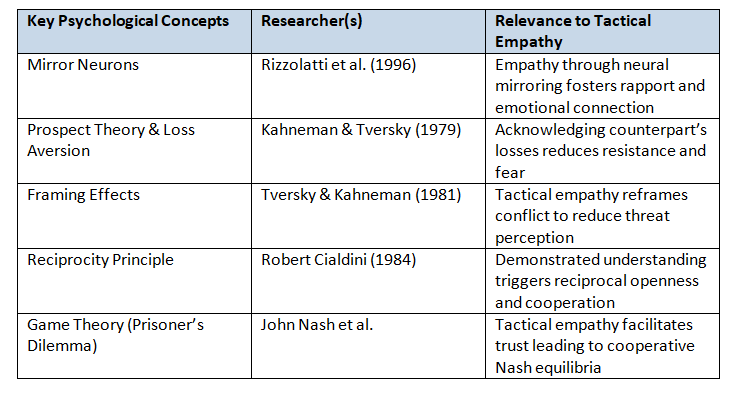
From a neurological perspective, mirror neurons play a critical role. Discovered by Rizzolatti et al. (1996), these neurons fire both when an individual performs an action and when they observe another performing it, facilitating emotional resonance and social understanding. Tactical empathy leverages this by consciously mirroring language and emotional tone, activating the counterpart’s mirror neuron systems and fostering unconscious affiliation.
Behavioral economics offers further explanation. Daniel Kahneman’s Prospect Theory (1979) highlights that people weigh losses more heavily than gains, leading to loss aversion. Tactical empathy acts by identifying and acknowledging the counterpart’s losses, anxieties, or threats, reducing their sense of risk and increasing willingness to cooperate. Moreover, the concept of framing effects (Tversky & Kahneman, 1981) shows that how information is presented impacts decisions. Tactical empathy reframes situations to reduce perceived threat and increase perceived shared interest.
Robert Cialdini’s principles of influence directly intersect with tactical empathy. The reciprocity principle is activated when negotiators demonstrate genuine understanding, prompting counterparts to reciprocate openness. Commitment and consistency are engaged as labels (“It seems like you feel…”) encourage counterparts to own and clarify their emotions, making them more predictable and manageable.
Chris Voss, former FBI lead hostage negotiator and author of "Never Split the Difference," formalized tactical empathy as a deliberate technique. His research emphasizes tactical empathy’s capacity to create rapport in high-stress, zero-sum environments by prioritizing emotional intelligence over traditional logic-driven negotiation.
Game theory perspectives—such as the Prisoner’s Dilemma and Nash equilibrium—reflect how tactical empathy can shift negotiations from adversarial stalemates to cooperative equilibria. By signaling understanding and reducing mistrust, negotiators can escape suboptimal outcomes and find mutually beneficial solutions.
How This Tactic Works in Practice
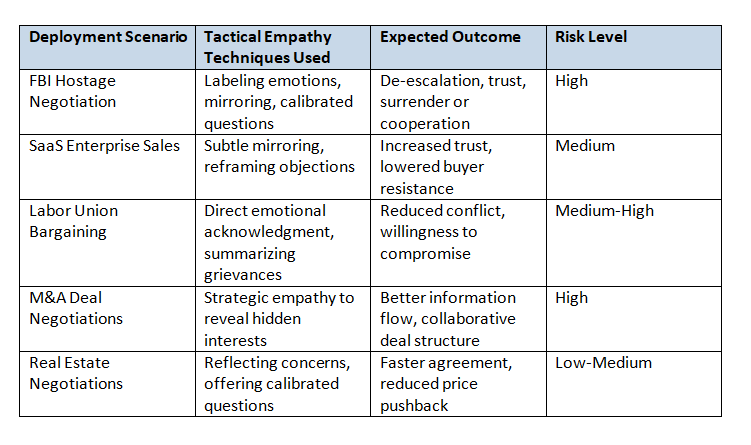
Tactical empathy encompasses a spectrum of behaviors from subtle emotional mirroring to direct verbal labeling that identifies counterpart emotions. Its deployment varies according to context, power dynamics, and stakes involved.
On the subtle end, a negotiator may mirror tone and body language without explicit verbal acknowledgment, building subconscious rapport. In more overt uses, the negotiator uses calibrated questions ("What about this situation worries you the most?"), labeling ("It seems like you’re frustrated with the timeline"), and summarizing emotions to demonstrate deep understanding.
Variations include:
- Tactical Empathy in High-Stakes Hostage Negotiation: Explicit verbal labeling and calibrated questions to defuse tension rapidly.
- Business-to-Business Sales: Subtle mirroring combined with strategic framing to build trust over multiple meetings.
- Labor Union Negotiations: Direct acknowledgment of fears and losses to reduce adversarial stances and open compromise.
The expected outcomes span improved rapport, reduced emotional resistance, increased disclosure, and ultimately higher deal closure rates.
Step-by-Step: How to Deploy This Tactic
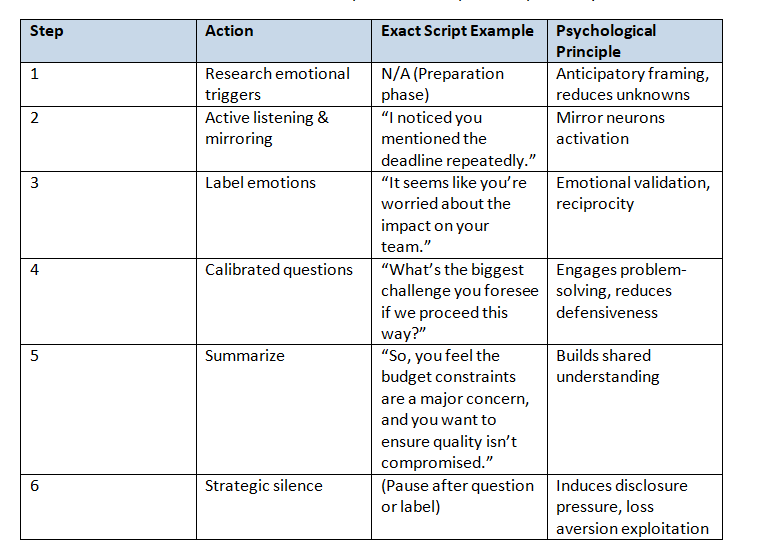
Step 1: Prepare by Researching Counterpart’s Emotional Landscape
Before engaging, anticipate the counterpart’s emotional priorities, fears, and motivations. Use intelligence or prior interactions to map potential emotional triggers.
Step 2: Establish Rapport Through Active Listening
Use open body language, maintain eye contact, and allow silences. Practice mirroring the counterpart’s speech patterns, pace, and tone subtly to build unconscious connection.
Sample language: "I hear you saying the timeline is tight."
Step 3: Use Labeling to Identify Emotions
Verbalize observed feelings without judgment. Use phrases like, “It seems like you’re concerned about…” or “It sounds like this has been frustrating for you.”
This triggers counterpart validation and encourages elaboration.
Step 4: Employ Calibrated Questions to Guide Thought Process
Ask open-ended questions that prompt reflection and problem-solving, such as “How can we ensure this solution meets your key objectives?” Avoid yes/no questions.
Step 5: Summarize and Paraphrase to Demonstrate Understanding
Periodically restate what you’ve heard in your own words, integrating emotional and factual content. This confirms accuracy and deepens trust.
Step 6: Use Tactical Pauses and Silence Strategically
After labeling or asking calibrated questions, pause to allow the counterpart to fill the silence with disclosures or concessions. Silence increases pressure to respond cooperatively.
How to Recognize and Counter This Tactic
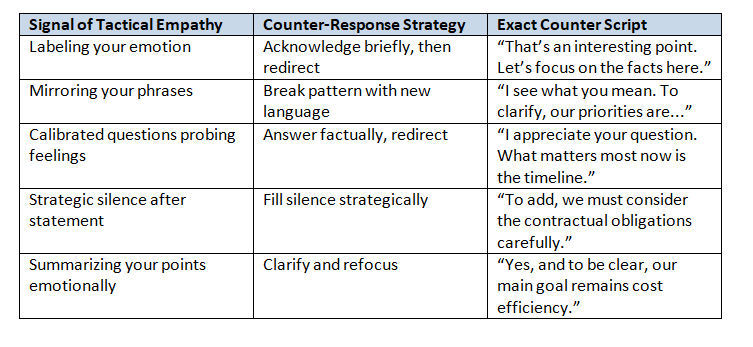
When someone uses tactical empathy against you, it can feel like they "know your mind" or "get inside your head"—a subtle but potent influence. Recognizing signs helps maintain control and avoid manipulation.
Signals include:
- Frequent reflective statements or labels directed at your emotions.
- Calibrated questions designed to elicit specific disclosures.
- Mirroring of your language and body language.
- Strategic pauses to elicit concessions.
Counter-responses focus on maintaining emotional boundaries, redirecting conversations, and employing your own calibrated questioning.
Real-World Case Studies
Case Study 1: Apple vs Samsung Patent Negotiations
In the protracted patent infringement battles, Apple’s legal team employed tactical empathy during settlement talks. By acknowledging Samsung’s concerns about market share loss and framing negotiations around mutual innovation benefits, Apple reduced Samsung’s defensive posture, culminating in a lucrative licensing agreement. The key lesson: tactical empathy enabled a shift from adversarial litigation to collaborative resolution.
Case Study 2: NFL Contract Disputes
During the 2011 NFL lockout, union negotiators used tactical empathy to recognize team owners’ financial pressures, openly labeling economic uncertainties. This fostered trust and paved the way for a negotiated collective bargaining agreement. Conversely, misapplication by some owners—ignoring emotional context—prolonged conflict, illustrating the tactic’s critical role in labor negotiations.
Case Study 3: FBI Hostage Negotiations – The Denise Huskins Case
FBI negotiators successfully used tactical empathy to build rapport with hostage-takers, labeling their fears and frustrations, which de-escalated the situation and led to a peaceful resolution. The negotiators’ ability to listen empathetically and respond with calibrated questions prevented violence and saved lives.
Common Mistakes When Using This Tactic
· Over-labeling emotions: Repeated or inaccurate labeling can appear manipulative and provoke resistance.
· Ignoring cultural differences: Emotional expressions vary culturally, requiring nuanced application.
· Using tactical empathy without genuine intent: Insincerity is often detected, undermining trust.
· Failing to balance emotional with logical appeals: Overreliance on emotions may neglect critical factual concerns.
· Neglecting timing: Deploying tactical empathy too early or late can reduce its effectiveness.
Fixes include calibrating labels carefully, incorporating cultural intelligence, aligning empathy with authentic intent, blending emotional and rational elements, and sequencing tactics appropriately.
Scripts and Templates
Script 1: Email — Initial Outreach Using Tactical Empathy
Subject: Understanding Your Priorities to Find the Best Solution
Dear [Name],
It seems like meeting your project timeline is a critical concern for you. I’d like to understand more about the challenges you’re facing so we can tailor our proposal accordingly. What are the key obstacles that might impact your decision?
Looking forward to your thoughts.
Best regards,
Script 2: In-Person Meeting — Labeling and Calibrated Question
“It sounds like the recent changes have created some uncertainty about the budget. How do you see this affecting your team’s ability to move forward?”
Script 3: Phone Negotiation — Mirroring and Summarizing
Counterpart: “We’re worried that the costs will spiral out of control.”
You: “Costs spiraling out of control?”
Counterpart: “Yes, the initial quotes don’t seem to cover all the expenses.”
You: “So, you’re concerned the budget estimates might be incomplete, and that’s creating hesitation on your end.”
Script 4: Countering Tactical Empathy — Redirecting Label
Them: “It seems like you’re frustrated with the current proposal.”
You: “I appreciate your observation. Let’s focus on the core terms to ensure we’re aligned on the deal structure.”
Script 5: Email — Calibrated Question to Break Deadlock
Subject: Finding a Path Forward
Hi [Name],
Given the points we’ve discussed, what do you think would address your primary concerns sufficiently to move toward agreement?
Best,
Frequently Asked Questions
Q1: What is tactical empathy in negotiation and how does it differ from regular empathy?
Tactical empathy is the deliberate use of empathy to influence and guide negotiation outcomes by recognizing, verbalizing, and strategically responding to the counterpart’s emotions. Unlike general empathy, which is passive understanding, tactical empathy is active, goal-oriented, and often involves calibrated communication techniques.
Q2: Can tactical empathy be used in high-pressure business deals?
Absolutely. Tactical empathy helps defuse tension, uncover hidden interests, and build trust, making it valuable in complex negotiations such as mergers, sales, or contract disputes, where emotional dynamics often drive decisions.
Q3: How do I avoid sounding insincere when using tactical empathy?
Authenticity is critical. Focus on genuinely understanding your counterpart’s perspective and avoid overusing labels. Use your own emotional intelligence to tailor communication and listen actively to maintain sincerity.
Q4: What are the best ways to recognize when someone is using tactical empathy on me?
Look for repeated reflective statements, emotional labeling, calibrated open-ended questions, and mirroring of your language or body posture. If you feel the conversation is being steered emotionally, tactical empathy is likely in play.
Q5: How can I effectively counter tactical empathy without escalating conflict?
Acknowledge the label briefly to avoid confrontation, then steer the discussion back to facts and your priorities with clear, direct language. Use your own calibrated questions to regain control and maintain a collaborative tone.
Conclusion
Tactical empathy, as pioneered by FBI negotiators and illuminated by behavioral science, offers a transformative approach to negotiation. By consciously recognizing and articulating the emotions of your counterpart, you unlock pathways to trust, information sharing, and cooperative problem-solving. Its power lies in bridging the emotional divide inherent in even the most contentious negotiations, turning adversaries into collaborators.
Mastering tactical empathy requires preparation, precise language, and situational awareness. Equally important is understanding how to recognize and counter it when others use the tactic. Whether closing multimillion-dollar deals, resolving labor disputes, or managing crises, tactical empathy should be a foundational skill in every negotiator’s toolkit. Begin integrating its principles today with the step-by-step frameworks and scripts provided here, and elevate your negotiation outcomes to new heights.
References
Fisher, R., Ury, W., & Patton, B. (2011). Getting to Yes: Negotiating Agreement Without Giving In. Penguin Books.
Kahneman, D., & Tversky, A. (1979). Prospect Theory: An Analysis of Decision under Risk. Econometrica, 47(2), 263-291.
Cialdini, R. B. (1984). Influence: The Psychology of Persuasion. Harper Business.
Voss, C. (2016). Never Split the Difference: Negotiating As If Your Life Depended On It. Harper Business.
Rizzolatti, G., & Craighero, L. (2004). The Mirror-Neuron System. Annual Review of Neuroscience, 27, 169–192.
Shell, R. G. (2006). Bargaining for Advantage: Negotiation Strategies for Reasonable People. Penguin.