Tactical Mistakes in Negotiation That Cost You Deals: The Definitive Guide for Professionals

Negotiations are high-stakes arenas where one misstep can mean the difference between a lucrative deal and a lost opportunity. Consider the 2012 patent negotiations between Apple and Samsung, where Apple’s aggressive anchoring and failure to calibrate concessions led to a protracted legal battle rather than a swift settlement. The psychological pressure, strategic miscalculations, and tactical errors turned what could have been a business alliance into a costly public feud. This real-world example underscores how even top-tier negotiators can falter when tactical errors cloud judgment.
At the core of many negotiation failures lie deeply ingrained psychological biases and misapplied strategic principles. Research by Kahneman on anchoring and prospect theory reveals how negotiators often fixate on initial offers, losing sight of value creation. Cialdini’s principles of reciprocity and commitment can be weaponized or ignored, resulting in deadlocks or premature concessions. Moreover, the absence of tactical empathy—championed by Chris Voss—leads to misunderstandings and missed opportunities to build rapport or defuse tension. The stakes are high: failing to recognize and avoid these tactical mistakes can cost millions in lost revenue, damaged relationships, or strategic positioning.
This comprehensive guide will equip you with actionable insights to identify and correct the tactical mistakes that undermine your negotiation outcomes. You will master proven behavioral frameworks like Fisher & Ury’s principled negotiation, Shell’s bargaining tactics, and Voss’s tactical empathy approach. Additionally, you’ll receive precise counter-tactic scripts, psychological recognition matrices, and real-world case studies that illustrate when and how these errors arise. Whether negotiating multi-million dollar M&A deals, high-stakes labor contracts, or complex diplomatic agreements, this definitive resource will elevate your negotiation prowess to a level where you no longer lose deals due to avoidable tactical errors.
· Table of Contents
· The Psychology and Science Behind Tactical Mistakes in Negotiation
· Key Frameworks and Models for Avoiding Tactical Errors
· Step-by-Step Process to Identify and Correct Tactical Mistakes
· Real-World Case Studies Illustrating Costly Negotiation Errors
· Recognition and Counter-Response Guide to Common Negotiation Tactics
· Advanced Insights for Elite Negotiators
· Scripts and Templates: Exact Words to Avoid Tactical Pitfalls
· Frequently Asked Questions on Tactical Negotiation Mistakes
· Conclusion: Synthesizing Lessons and Your Path Forward
· References
The Psychology and Science Behind This Topic
Negotiation is fundamentally a psychological contest shaped by cognitive biases, social heuristics, and emotional dynamics. Foundational research by Daniel Kahneman and Amos Tversky has shown that negotiators often fall prey to anchoring bias—fixating on initial offers regardless of underlying value—or loss aversion, where fear of losses drives irrational concessions. For example, in prospect theory, negotiators overweight potential losses compared to equivalent gains, often leading to overly defensive or risk-averse positions.
Robert Cialdini’s principles of influence—particularly reciprocity, scarcity, and social proof—play a hidden but powerful role in negotiations. Misapplication of reciprocity, such as premature concessions without eliciting reciprocal behavior, can weaken one’s bargaining position. Similarly, ignoring social proof or scarcity signals can lead to missed leverage points. Chris Voss, a former FBI hostage negotiator, emphasizes tactical empathy to understand and label counterpart emotions, which research in emotional intelligence supports as a critical factor in building trust and defusing conflict.
Game theory provides a structural lens on negotiation mistakes. Many negotiators behave as if in a zero-sum prisoner's dilemma, assuming fixed pie distributions rather than exploring positive-sum outcomes. This results in premature positional bargaining instead of mutually beneficial integrative solutions described by Fisher and Ury’s “Getting to Yes.” Power dynamics, as analyzed by Machiavelli and Sun Tzu, also influence tactical errors when negotiators misjudge their relative leverage or fail to anticipate power plays.
In essence, tactical mistakes in negotiation arise from a complex interplay of cognitive biases, emotional mismanagement, and strategic miscalculations. Understanding these psychological and behavioral mechanisms is essential to recalibrating approach and maximizing outcomes.
Key Frameworks and Models
Several established negotiation frameworks help negotiators avoid tactical errors by structuring strategy and psychology effectively. Here we compare three foundational models: Fisher & Ury’s Principled Negotiation, Richard Shell’s Bargaining for Advantage, and Chris Voss’s Tactical Empathy Framework.
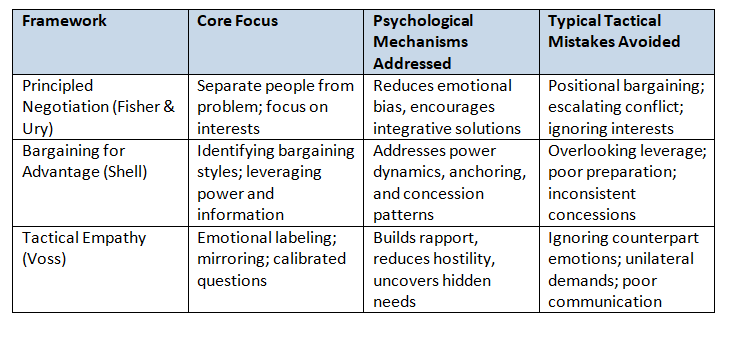
These frameworks complement each other: Principled Negotiation offers a structural approach to issue framing, Bargaining for Advantage hones in on tactical power and style, while Tactical Empathy enriches emotional intelligence and communication nuances. A skilled negotiator integrates elements of all three to avoid common tactical traps.
Step-by-Step Process or Analysis
This section provides a detailed six-step process to identify and rectify tactical mistakes during negotiations, with exact language and psychological timing guidance.
Step 1: Preparation and Power Assessment
Before engagement, conduct a rigorous BATNA (Best Alternative to a Negotiated Agreement) analysis and power mapping. Evaluate your leverage versus the counterpart’s, including informational asymmetries and timing pressures. Use Shell’s “power sources” matrix to classify leverage types (legitimate, reward, coercive, expert, referent).
Psychological tip: Counteract overconfidence bias by soliciting devil’s advocacy on your BATNA assumptions.
Script: “To ensure we’re aligned on options, can you share your fallback plan if we can’t reach agreement today?”
Step 2: Anchoring and Framing the Opening Offer
Anchoring is a double-edged sword. Present your initial offer strategically high or low within realistic bounds to set the negotiation anchor, but avoid unrealistic extremes that damage credibility.
Psychological timing: Anchor early to influence counterpart reference points. Use framing to emphasize gains rather than losses (loss aversion).
Script: “Based on market data and our valuation, we propose $X as a starting point, which reflects the premium value we anticipate.”
Step 3: Tactical Empathy and Mirroring
Listen actively and validate counterpart emotions and concerns to build rapport. Use mirroring (repeating last few words) and labeling (naming emotions) to encourage disclosure.
Psychological mechanism: Labeling reduces defensiveness; mirroring triggers subconscious rapport.
Script: “It seems you’re concerned about the timeline. That’s understandable given the stakes involved.”
Step 4: Calibrated Questions to Uncover Interests
Ask open-ended, calibrated questions that make the counterpart solve your problem or reveal hidden interests.
Script: “How can we structure this deal to ensure it meets your growth objectives?”
Psychological effect: Encourages collaboration; reduces adversarial stance.
Step 5: Managing Concessions and Reciprocity
Plan concessions strategically to elicit reciprocal moves. Avoid unilateral concessions without explicit reciprocity commitments.
Psychological principle: Based on Cialdini’s reciprocity, unreciprocated concessions weaken your position.
Script: “If you can agree on the pricing structure, we are prepared to expedite delivery timelines.”
Step 6: Closing with Summarizing and Confirming Agreement
Summarize agreed points clearly and seek explicit confirmation to avoid misunderstandings.
Script: “To confirm, we are aligned on price X, delivery by date Y, and service terms Z. Do you agree with this summary?”
Psychological benefit: Reinforces commitment and reduces post-agreement disputes.
Real-World Case Studies
Case Study 1: Apple vs Samsung Patent Negotiations (2012)
Context: Apple aggressively anchored with high damage claims, Samsung responded with counter-anchors and legal posturing.
Tactical Mistake: Apple’s failure to calibrate initial offer and disregard for interest-based negotiation escalated conflict.
Lesson: Anchoring must be credible and accompanied by tactical empathy to explore mutually beneficial outcomes.
Case Study 2: NFL Contract Negotiations – 2011 Lockout
Context: NFL owners and players failed to appreciate each other’s BATNA and misread power dynamics.
Tactical Mistake: Both sides engaged in zero-sum positional bargaining ignoring integrative solutions, prolonging lockout.
Lesson: Understanding power sources and preparing BATNA comprehensively prevents costly stalemates.
Case Study 3: US-Iran Nuclear Deal Negotiations (2015)
Context: Diplomats used calibrated questions and tactical empathy to uncover hidden interests and defuse hostility.
Tactical Mistake Avoided: Neither side anchored unrealistically or failed to manage emotions.
Lesson: Emotional intelligence and open-ended questioning create pathways for complex diplomatic resolutions.
Recognition and Counter-Response Guide
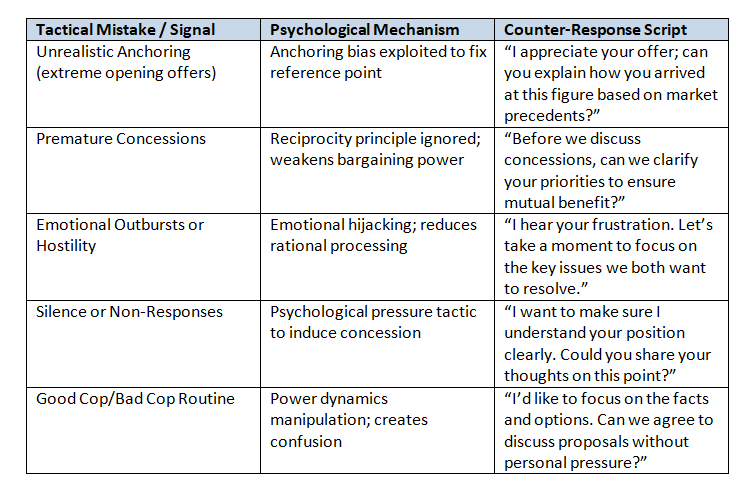
This table maps common tactical mistakes or signals to their psychological underpinnings and provides exact counter-response scripts.
Advanced Insights
Elite negotiators integrate subtle behavioral cues and leverage temporal tactics beyond beginner guides. For example, using the “accusation audit” from Voss preempts counterpart objections by acknowledging perceived negatives upfront, reducing resistance. Timing concessions at psychologically impactful moments—such as after gaining agreement on smaller issues—capitalizes on the commitment principle to build momentum. Furthermore, recognizing opponent’s negotiation style from Shell’s typology (accommodator, competitor, avoider, etc.) allows tailored communication strategies.
Game theory informs that shifting negotiations from zero-sum to positive-sum frames creates value. This involves identifying “expand the pie” options before dividing it. It also entails anticipating and countering power plays using Machiavellian insights—detecting when counterparts use threats or signaling to manipulate leverage.
Advanced negotiators also use “calibrated no” — phrasing refusals in a way that invites further dialogue rather than shuts down conversations, e.g., “I’m not comfortable with that approach; how else might we tackle this?”
Scripts and Templates
Script 1: Responding to an Unrealistic Anchor
“I hear your starting number, and I want to understand how it fits with the market benchmarks we’ve reviewed. Could you walk me through the rationale behind it?”
Script 2: Using Tactical Empathy to Defuse Hostility
“It sounds like this issue has been frustrating for you, which makes sense given the complexity. Let’s work together to find a solution that addresses your concerns.”
Script 3: Strategic Concession with Reciprocity Request
“If we can agree on the key deliverables today, we are prepared to consider a flexible payment schedule. Would that work for you?”
Script 4: Calibrated Question to Uncover Hidden Interests
“How can we adjust the terms so that both sides feel confident moving forward?”
Script 5: Closing Summary and Confirmation
“To ensure we’re on the same page, we’ve agreed on X, Y, and Z. Does this capture your understanding as well?”
Frequently Asked Questions
Q1: What are the most common tactical mistakes negotiators make?
A1: Common mistakes include unrealistic anchoring, premature concessions without reciprocity, neglecting tactical empathy, failing to prepare BATNA, and ignoring power dynamics. These errors often stem from cognitive biases like anchoring bias and loss aversion, as well as emotional mismanagement.
Q2: How can I recognize when I am being manipulated by negotiation tactics?
A2: Signs include feeling pressured without full information, encountering extreme opening offers, experiencing emotional triggers, or noticing inconsistent concession patterns. Awareness of psychological mechanisms such as reciprocity, anchoring, and social proof helps you identify these tactics.
Q3: What frameworks are best for avoiding negotiation mistakes?
A3: Combining Fisher & Ury’s Principled Negotiation for issue framing, Shell’s Bargaining for Advantage for power awareness, and Voss’s Tactical Empathy for emotional intelligence provides a robust toolkit to avoid tactical errors.
Q4: How do I respond when the other party makes an unrealistic opening offer?
A4: Use calibrated questions to understand their rationale, label the offer’s extremity empathetically, and re-anchor with data-based counteroffers. For example: “Can you help me understand how you arrived at that figure?”
Q5: Can tactical empathy really improve negotiation outcomes?
A5: Yes. Tactical empathy builds rapport, reduces defensiveness, and encourages openness, enabling negotiators to uncover hidden interests and craft mutually beneficial solutions. This approach is supported by research in emotional intelligence and has been proven effective in hostage and business negotiations.
Conclusion
Tactical mistakes in negotiation are costly, often invisible traps that erode value and damage relationships. By understanding the deep psychological roots of these errors—anchoring bias, loss aversion, emotional mismanagement—and applying proven frameworks like Principled Negotiation, Bargaining for Advantage, and Tactical Empathy, negotiators can transform their approach from reactive to strategic. The ability to recognize manipulation tactics, calibrate responses, and deploy precise language scripts separates elite negotiators from those who routinely lose deals.
Now is the time to elevate your negotiation strategy by integrating these insights, frameworks, and practical tools. Review your past negotiations for recurring tactical errors, apply the step-by-step process outlined here, and practice the scripts to build confidence. The difference between winning and losing in negotiation is often tactical mastery. Commit today to mastering these techniques and never lose a deal due to an avoidable mistake again.
References
1. Fisher, R., & Ury, W. (1981). Getting to Yes: Negotiating Agreement Without Giving In. Penguin Books.
2. Kahneman, D. (2011). Thinking, Fast and Slow. Farrar, Straus and Giroux.
3. Cialdini, R. B. (2006). Influence: The Psychology of Persuasion. Harper Business.
4. Shell, G. R. (2006). Bargaining for Advantage: Negotiation Strategies for Reasonable People. Penguin Books.
5. Voss, C., & Raz, T. (2016). Never Split the Difference: Negotiating As If Your Life Depended On It. HarperBusiness.
6. Bazerman, M. H., & Neale, M. A. (1992). Negotiating Rationally. Free Press.