Tactical Questioning Techniques in Negotiation: The Definitive Professional Guide

Imagine a high-stakes corporate merger negotiation between two global tech giants, where billions of dollars and thousands of jobs hang in the balance. The lead negotiator, facing an elusive counterpart, expertly deploys a series of calibrated questions that unlock hidden information, revealing underlying priorities and constraints that traditional demands could never surface. Within hours, what seemed like an impasse transforms into a collaborative agreement, saving both firms from protracted legal battles and market uncertainty.
This scenario exemplifies the power and peril of tactical questioning in negotiation. Far too many negotiators default to direct demands, aggressive ultimatums, or passive acquiescence, missing the nuanced psychological levers that can shift dynamics dramatically. Research in behavioral economics and negotiation science—from Daniel Kahneman’s anchoring effects to Chris Voss’s tactical empathy—reveals that the questions you ask, how you frame them, and when you use silence can create leverage, build rapport, and compel disclosure without triggering defensiveness or hostility.
In this comprehensive guide, you will master the art and science of tactical questioning techniques. We will unpack the psychology underpinning effective questions, present frameworks such as calibrated questioning and the accusation audit, provide a detailed step-by-step process with precise scripts, analyze real-world case studies from corporate negotiations and diplomatic standoffs, and offer advanced strategies and countermeasures every seasoned professional needs. Whether you are a lawyer, sales director, or senior negotiator, this article will equip you with actionable tools to elevate your questioning game to elite levels.
· Table of Contents
· The Psychology and Science Behind Tactical Questioning in Negotiation
· Key Frameworks and Models for Tactical Questioning
· Step-by-Step Tactical Questioning Process with Scripts
· Real-World Case Studies Demonstrating Tactical Questioning
· Recognition and Counter-Response Guide: Defending and Deploying Questions
· Advanced Insights for Expert-Level Questioning
· Essential Scripts and Templates for Common Negotiation Scenarios
· Frequently Asked Questions on Tactical Questioning Techniques
· Conclusion and Next Steps
· References
The Psychology and Science Behind This Topic
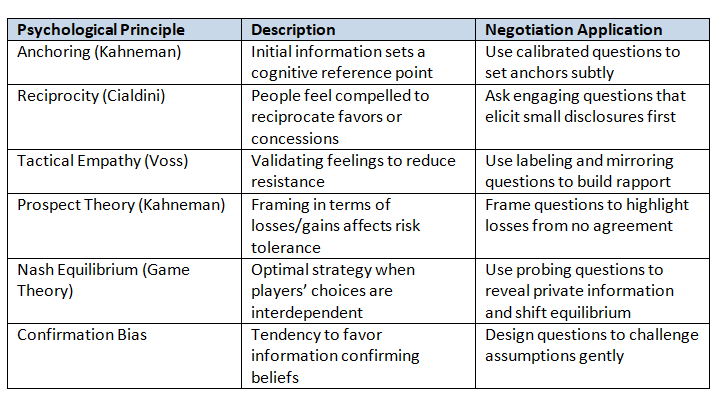
Tactical questioning in negotiation leverages fundamental principles of cognitive psychology and behavioral economics to influence decision-making and information exchange. Daniel Kahneman’s prospect theory highlights how framing questions around losses rather than gains can shift risk preferences, while anchoring effects show that initial questions set cognitive baselines that influence subsequent judgments. For example, an early calibrated question such as “How am I supposed to accept that price?” sets an implicit anchor and invites the counterpart to justify or reconsider the offer.
Robert Cialdini’s principles of influence—especially reciprocity and commitment—play a critical role. Questions that elicit small concessions or admissions increase the likelihood of larger agreements later, as individuals seek to remain consistent with prior commitments. Chris Voss’s tactical empathy framework applies here by recommending labeling and mirroring questions that validate emotions and build trust, reducing resistance and increasing disclosure: “It seems like this timeline is challenging for you. What’s driving that?”
Game theory contributes an understanding of strategic questioning as moves in an iterative game. Nash equilibrium concepts imply that well-crafted questions can reveal private information and shift payoffs toward mutually beneficial outcomes in complex negotiations like mergers or diplomatic talks. Conversely, questions can serve as bluffs or probes to test opponent boundaries, requiring keen psychological acuity to detect.
Cognitive biases such as confirmation bias and the availability heuristic affect how negotiators interpret and respond to questions, sometimes leading to suboptimal concessions or information withholding. Skilled negotiators anticipate these biases and design questions that circumvent or exploit them, creating a dynamic interplay between inquiry, influence, and information control.
Key Frameworks and Models
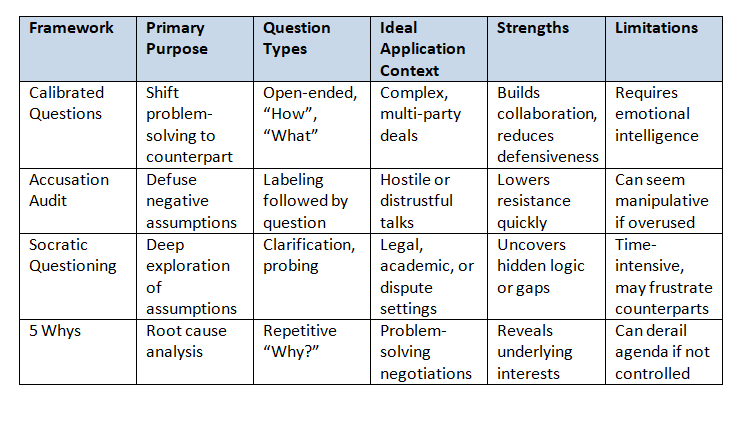
Several structured frameworks guide the deployment of tactical questions to maximize influence and information gain.
1. **Calibrated Questions (Chris Voss)**
Calibrated questions are open-ended, designed to make the counterpart solve your problem for you. Typical formats include “How…” and “What…” questions that encourage collaborative thinking and reduce defensiveness. Examples: “How am I supposed to do that?” or “What is the biggest challenge you face with this proposal?”
2. **Accusation Audit (Chris Voss)**
This preemptive technique involves verbalizing negative assumptions the counterpart might hold, followed by a question that defuses those concerns. This disarms hostility and opens channels for honest dialogue. Example: “You probably think I’m being unreasonable with this timeline, but what would it take to make it work for you?”
3. **Socratic Questioning (Philosophical Model)**
A disciplined questioning sequence that probes assumptions, evidence, and implications to uncover deeper truths and clarify positions. It is structured around five types: clarification, probing assumptions, evidence, viewpoints, and consequences.
4. **The 5 Whys (Lean Methodology)**
Repeatedly asking “Why?” to drill down to root causes, often revealing hidden interests or constraints driving negotiation stances.
Step-by-Step Process or Analysis
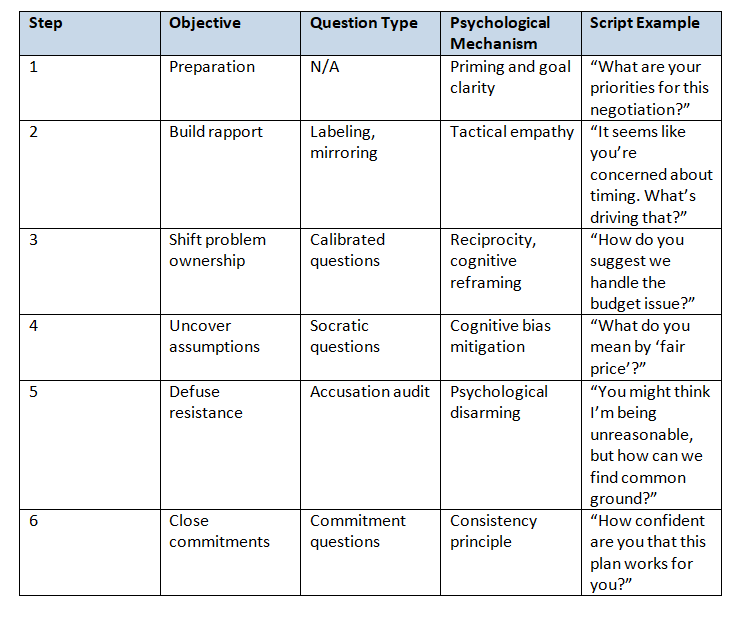
Mastering tactical questioning requires a deliberate, sequenced approach. Below are six essential steps, each with tactical guidance.
Step 1: Preparation and Objective Setting
Before the negotiation, clarify your goals and identify information gaps. Anticipate the counterpart’s interests and possible objections. Prepare a list of calibrated questions aligned to these objectives.
Psychological Tip: By anticipating objections, you prime yourself to apply the accusation audit and avoid reactive defensiveness.
Script Example: “Before we begin, I’d like to understand your main priorities on this deal.”
Step 2: Establish Rapport and Build Tactical Empathy
Open with labeling and mirroring questions to validate emotions and build psychological safety. This reduces resistance to subsequent probing.
Script: “It sounds like timing is a major concern for you. What about that timeline is most challenging?”
Timing: Use early in the conversation to set tone.
Step 3: Deploy Calibrated Questions to Shift Problem Ownership
Use open-ended calibrated questions to invite the counterpart to solve your problems, which increases their buy-in.
Script: “How do you suggest we address the budget constraints you mentioned?”
Psychological Guidance: These questions force the other party to consider your constraints as their own.
Step 4: Use Socratic Questioning to Uncover Assumptions
Ask clarifying and probing questions to reveal hidden assumptions or conflicting goals.
Script: “What do you mean by ‘fair price’ in this context?”
Cognitive Bias Alert: Watch for confirmation bias and gently challenge it.
Step 5: Apply the Accusation Audit to Defuse Resistance
Preemptively state potential negative perceptions followed by a question that invites collaboration.
Script: “You might think I’m pushing too hard on deadlines, but what could we do to make the schedule workable for both sides?”
Step 6: Confirm Understandings and Close with Commitment Questions
Use commitment-oriented questions to secure alignment and increase the cost of backtracking.
Script: “Given what we’ve discussed, how confident are you that we can move forward on these terms?”
Timing: End of the negotiation phase before formalizing agreements.
Real-World Case Studies
Case Study 1: Apple vs Samsung Patent Negotiations
During protracted patent disputes, Apple’s legal team employed calibrated questioning in settlement talks to uncover Samsung’s key vulnerabilities and constraints. By asking “How do you justify continuing these costly lawsuits rather than settling?” Apple shifted Samsung’s framing from aggressive litigation to cooperative resolution, ultimately securing licensing agreements that preserved Apple’s market lead.
Lesson: Calibrated questions can reveal and reshape opponent incentives in high-stakes intellectual property disputes.
Case Study 2: NFL Contract Negotiation with Star Player
In a tense NFL contract negotiation, the player’s agent used accusation audit by stating, “You probably think the asking salary is too high given recent injuries, but what would make you comfortable moving forward?” This led to a collaborative discussion on performance incentives rather than base salary, aligning interests and avoiding a holdout.
Lesson: Accusation audits reduce adversarial framing and open paths to creative solutions.
Case Study 3: Diplomatic Negotiations in the Iran Nuclear Deal
Negotiators from multiple countries used Socratic questioning to clarify ambiguous terms and underlying assumptions about inspections and sanctions. Repeated “What if…” and “How would…” questions exposed conflicting interpretations and allowed for precise language crafting that avoided future disputes.
Lesson: Socratic questioning uncovers hidden assumptions critical in complex multiparty diplomacy.
Recognition and Counter-Response Guide
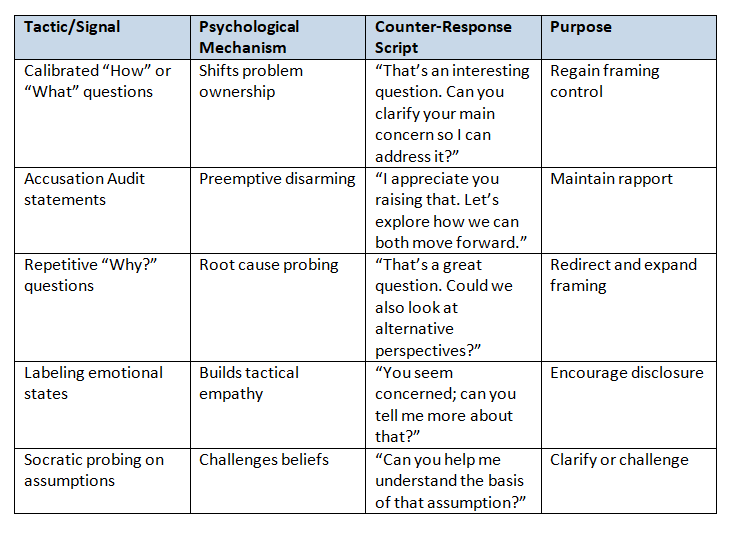
Effective negotiators must identify when tactical questioning is employed against them and counter it skillfully. Below is a framework mapping common questioning tactics to their psychological underpinnings and example counter-responses.
Advanced Insights
Beyond foundational techniques, elite negotiators integrate subtle psychological levers and strategic timing to amplify questioning impact. For example:
- **Silence after a calibrated question** exploits loss aversion and discomfort, compelling the counterpart to fill the void with concessions or information.
- **Anchoring with a question**: Instead of stating a number, ask “How do you justify that price?” setting an implicit cognitive anchor without overt commitment.
- **Multi-party triangulation**: Asking questions that indirectly reference absent stakeholders can pressure counterparts to reveal more or reconsider positions.
- **Meta-questions**: Questions about the negotiation process itself, e.g., “How do you think we should navigate disagreements?” create collaborative problem-solving mindsets.
- **Mirroring combined with calibrated questioning**: Reflecting the last few words of the counterpart’s response followed by a calibrated question deepens engagement.
These techniques require emotional intelligence, timing, and practice to avoid appearing manipulative or insincere. High stakes negotiations—such as elite M&A deals or hostage negotiations—often hinge on these nuanced layers.
Scripts and Templates
Below are exact scripts designed for common tactical questioning scenarios:
1. **Calibrated Question for Budget Constraints**
“How do you suggest we work within your budget to achieve our goals?”
2. **Accusation Audit to Address Distrust**
“You may feel I’m pushing too aggressively here. What concerns do you have that we can address together?”
3. **Socratic Question for Clarification**
“When you say ‘fair terms,’ could you explain what specific elements you’re referring to?”
4. **Closing Commitment Question**
“Based on our discussion, how confident are you that this agreement meets your key priorities?”
5. **Defensive Counter to Repetitive ‘Why’ Questions**
“That’s a valuable question. Let’s also consider the bigger picture to ensure a sustainable solution.”
Frequently Asked Questions
Q1: What makes a question ‘calibrated’ in negotiation?
A1: Calibrated questions are open-ended inquiries designed to engage the counterpart in problem-solving rather than confrontation. They typically start with “How” or “What,” avoiding yes/no answers and inviting collaboration. Chris Voss popularized this approach as a method to shift ownership of issues to the other party.
Q2: How can I use tactical empathy questions without seeming insincere?
A2: Tactical empathy requires authentic emotional validation. Use labeling (“It sounds like you’re frustrated with the timeline”) and mirroring (“Timeline?”) genuinely. Avoid parroting mechanical phrases; instead, listen actively and reflect feelings accurately to build trust.
Q3: When is it appropriate to use the accusation audit?
A3: Use the accusation audit early when you anticipate or detect negative assumptions or hostility. By voicing potential objections before they arise, you reduce defensiveness and signal openness, facilitating more honest dialogue.
Q4: How do I handle repeated “Why” questions that feel like an interrogation?
A4: Politely redirect by acknowledging the question and broadening the scope: “That’s a great question. To answer it fully, we need to consider several factors…” This prevents the conversation from becoming adversarial while maintaining control.
Q5: Can tactical questioning be used in virtual or remote negotiations?
A5: Absolutely. Tactical questioning transcends medium. However, in virtual settings, pay extra attention to tone and pacing to ensure questions do not come across as abrupt. Use pauses deliberately and confirm understanding frequently.
Conclusion
Tactical questioning techniques are among the most potent tools in a professional negotiator’s arsenal, blending psychology, strategy, and communication science to unlock information, build rapport, and steer negotiations toward mutually beneficial outcomes. Mastery of calibrated questions, accusation audits, Socratic probing, and advanced questioning tactics in negotiation empowers negotiators to move beyond surface-level demands into rich, collaborative dialogues that generate value and durable agreements.
By integrating the frameworks, scripts, and countermeasures detailed in this guide, seasoned professionals can transform their negotiation approach—turning questions into strategic weapons that reveal hidden interests, defuse conflict, and ultimately close deals that might otherwise have faltered. Begin incorporating these techniques today to elevate your negotiation performance and secure success in even the most challenging scenarios.
References
- Voss, C., & Raz, T. (2016). Never Split the Difference: Negotiating As If Your Life Depended On It. Harper Business.
- Kahneman, D. (2011). Thinking, Fast and Slow. Farrar, Straus and Giroux.
- Cialdini, R. B. (2006). Influence: The Psychology of Persuasion. Harper Business.
- Fisher, R., Ury, W., & Patton, B. (2011). Getting to Yes: Negotiating Agreement Without Giving In. Penguin Books.
- Shell, G. R. (2006). Bargaining for Advantage: Negotiation Strategies for Reasonable People. Penguin Books.
- Grant, A. (2013). Give and Take: Why Helping Others Drives Our Success. Penguin Books.