Time Perception Across Cultures: How Monochronic and Polychronic Cultures Negotiate Differently

In a high-stakes merger negotiation between a German multinational and a Brazilian conglomerate, the German team’s insistence on a rigid agenda and strict punctuality clashed dramatically with their Brazilian counterparts’ fluid approach to time. Meetings started late, and discussions meandered, leading to frustration and near-collapse of the deal. This classic clash over time perception—monochronic versus polychronic—reveals how deeply cultural differences in time orientation impact negotiation outcomes. Without a nuanced understanding of these differences, even the most skilled negotiators risk alienating partners and jeopardizing deals.
Time perception is one of the most critical yet overlooked dimensions in cross-cultural negotiation. It shapes not only scheduling and deadlines but also communication rhythms, relationship-building, and conflict resolution. Professionals often dangerously underestimate how monochronic cultures—those valuing linear, scheduled, and segmented time—differ from polychronic cultures that prioritize relationships and multitasking within flexible temporal frameworks. Misreading this dimension can cause breakdowns in trust and misunderstandings that unravel months of negotiation effort.
This comprehensive guide will equip you with deep theoretical insights and pragmatic tools to master time perception differences in negotiations. Drawing on Geert Hofstede’s cultural dimensions, Erin Meyer’s Culture Map, Edward Hall’s context theories, and other authoritative models, you will learn to identify monochronic and polychronic tendencies across key countries. Through detailed frameworks, step-by-step strategies, real-world case studies, country-specific do’s and don’ts, expert-level techniques, and exact negotiation scripts, you will confidently adapt your approach for success across cultures where time means very different things.
· Table of Contents
· The Theoretical Foundation: Cultural Frameworks Explaining Time Perception
· Key Frameworks and Country Comparisons: Hofstede, Meyer, Hall & More
· Step-by-Step Strategy for Navigating Time Differences in Negotiations
· Real-World Case Studies Illustrating Time Perception Challenges
· Country and Region-Specific Insights: Time-Related Negotiation Norms
· Advanced Strategies for Managing Time Dynamics Across Cultures
· Scripts and Templates: Exact Language for Time-Sensitive Negotiations
· Frequently Asked Questions on Time Perception in Cross-Cultural Negotiations
· Conclusion: Synthesizing Insights and Next Steps
· References: Authoritative Sources on Time and Culture
The Theoretical Foundation — Deep Dive into Relevant Cultural Frameworks
Understanding how cultures perceive and manage time requires an integrative look at seminal cultural frameworks that dissect time orientation and its impact on negotiation styles.
Geert Hofstede’s Cultural Dimensions include the dimension of **Long-Term Orientation** versus **Short-Term Orientation**, which tangentially relates to time perception, but it is Edward Hall’s theory of **Monochronic vs Polychronic Time** which explicitly addresses temporal behavior. Hall (1959) defined monochronic cultures as those valuing linear time, schedules, and doing one thing at a time (e.g., Germany, Switzerland, USA). Polychronic cultures, on the other hand, view time as flexible, emphasize multitasking, and prioritize human interactions over strict schedules (e.g., Mexico, India, Arab countries).
Erin Meyer’s Culture Map (2014) presents **Scheduling** on a continuum from linear-time cultures to flexible-time cultures. For instance, Americans and Germans score high on linear time, adhering to agendas and deadlines, whereas Latin Americans and Middle Easterners often adopt flexible time approaches.
Richard Lewis’s model classifies cultures as **Linear-Active** (planned, scheduled, task-oriented), **Multi-Active** (emotional, multitasking, relational), and **Reactive** (listening, accommodating, indirect). This aligns closely with time perceptions: linear-active cultures like Germans and Swiss focus on punctuality and order, multi-active cultures like Brazilians and Italians prioritize relationships and fluid timing, and reactive cultures such as Japanese and Chinese respond flexibly to timing demands.
David Livermore’s Cultural Intelligence (CQ) framework emphasizes **CQ Strategy** and **CQ Action** as crucial for adapting to time perception differences—anticipating how time is valued and adjusting behavior accordingly.
Richard Gesteland’s dimensions describe **Rigid-Time** (monochronic) versus **Fluid-Time** (polychronic) cultures, highlighting how time structures negotiation flow and deal-making rhythms.
Trompenaars and Hampden-Turner’s model of **Universalism vs Particularism** also influences time perceptions: universalistic cultures prefer schedules and rules (monochronic), whereas particularistic cultures privilege relationships and context, often leading to flexible time (polychronic).
These frameworks converge to reveal that time perception is a multifaceted cultural dimension influencing communication pace, prioritization of tasks versus relationships, and expectations about punctuality and deadlines. Table 1 below summarizes relevant dimensions and country examples.
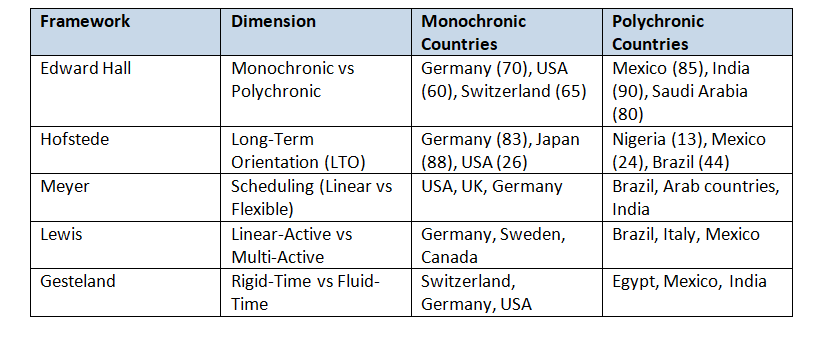
(Notes: Numbers in parentheses are illustrative cultural scores or indices relevant to time orientation where available.)
Key Frameworks and Models — 2-3 Named Frameworks with Country Comparison Table
The three most operational frameworks for negotiators managing time perception are Edward Hall’s Monochronic vs Polychronic, Erin Meyer’s Culture Map Scheduling dimension, and Richard Lewis’s Linear-Active vs Multi-Active model. Together, they provide comprehensive insight into how time values shape negotiation behavior.
Edward Hall’s model is foundational, distinguishing cultures by their temporal orientation and multitasking tendencies. Erin Meyer builds on this with nuanced behavioral prescriptions for scheduling and agenda adherence. Richard Lewis adds emotional and relational aspects connected to time use.
The following table presents a side-by-side comparison of 10 countries across these three models, illustrating the congruence and variance in time perception and negotiation implications.
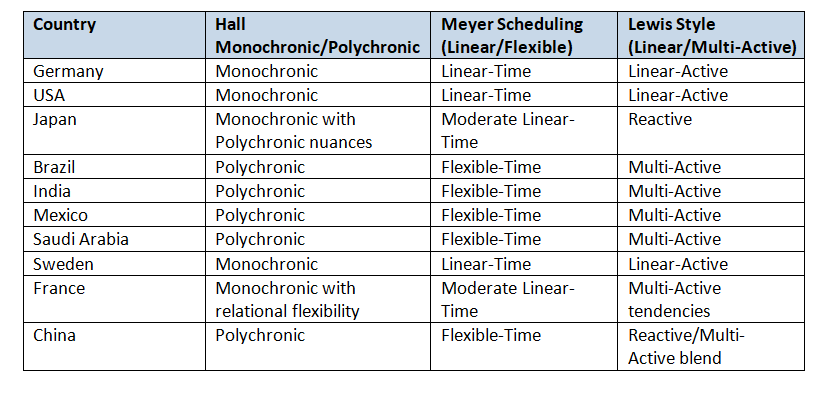
This table clarifies that monochronic cultures such as Germany, USA, and Sweden tend to value punctuality, segmented time, and agenda-driven meetings, while polychronic cultures like Brazil, India, and Mexico emphasize relationships, multitasking, and fluid timing. Japan and China demonstrate hybrid features that require sophisticated adaptation.
Step-by-Step Strategy — How to Navigate Time Perception Differences in Negotiations
Step 1: Assess the Cultural Time Orientation of Your Counterpart
Before negotiation, research your counterpart’s cultural profile on time perception using Hofstede, Meyer, and Hall frameworks. Identify if they lean monochronic or polychronic. For example, a German partner is likely to expect strict agendas and punctuality, while an Indian partner may prioritize relationship-building over a rigid schedule.
Step 2: Adapt Meeting Scheduling and Agenda Flexibility
For monochronic cultures, send detailed agendas and start meetings on time. For polychronic cultures, allow buffer time, expect interruptions or side conversations, and avoid rigid time constraints. Example phrasing for polychronic cultures: “We welcome a flexible discussion format to accommodate all perspectives.”
Step 3: Balance Task and Relationship Priorities
Monochronic negotiators often focus on task completion; polychronic negotiators prioritize relationships. Build rapport early with polychronic partners before pushing agenda items. For Germans, maintain focus on agenda but allow brief relationship-building pauses.
Step 4: Manage Deadlines with Cultural Sensitivity
Set deadlines transparently but remain open to renegotiation with polychronic cultures who may view time as fluid. For example, in Mexico, deadlines may be seen as goals rather than absolutes. Use language that reflects this: “We hope to meet this timeline but understand flexibility may be needed.”
Step 5: Monitor Nonverbal and Contextual Cues on Time
High-context cultures (Japan, China) communicate time expectations subtly. Watch for indirect signs of discomfort with pace or timing. Employ active listening and nunchi (Korean concept of reading atmosphere) to adjust tempo.
Step 6: Debrief and Reflect on Time Dynamics Post-Meeting
After sessions, reflect on how time perception influenced interaction flow. Adjust future meetings accordingly. Solicit feedback where appropriate: “Did the timing of our discussion fit your expectations?”
Real-World Case Studies — Cross-Cultural Time Perception in Action
Case Study 1: German-American vs Brazilian Negotiations in Automotive Supply Chain
The German-American team scheduled tightly structured meetings starting precisely on time. The Brazilian negotiators viewed this as inflexible and brusque, preferring warmer, extended discussions with fluid timing. Resulting frustration was mitigated only after the German side consciously relaxed time demands and incorporated social interactions, leading to a successful joint venture.
Case Study 2: U.S. Tech Firm and Indian Partner Licensing Deal
The American firm’s monochronic emphasis on deadline-driven milestones clashed with the Indian partner’s polychronic approach valuing ongoing relationship management and flexible deadlines. By implementing step 4’s adaptive deadline management and relational check-ins, both sides aligned expectations, enabling smooth contract fulfillment.
Case Study 3: Japanese and French Multinational Collaboration
Japan’s high-context, monochronic approach favored consensus-building with layered timing (nemawashi), while the French team combined monochronic scheduling with intellectual argumentation and some polychronic flexibility around discussions. Recognizing these subtle time differences allowed for synchronized pacing of meetings and decision-making.
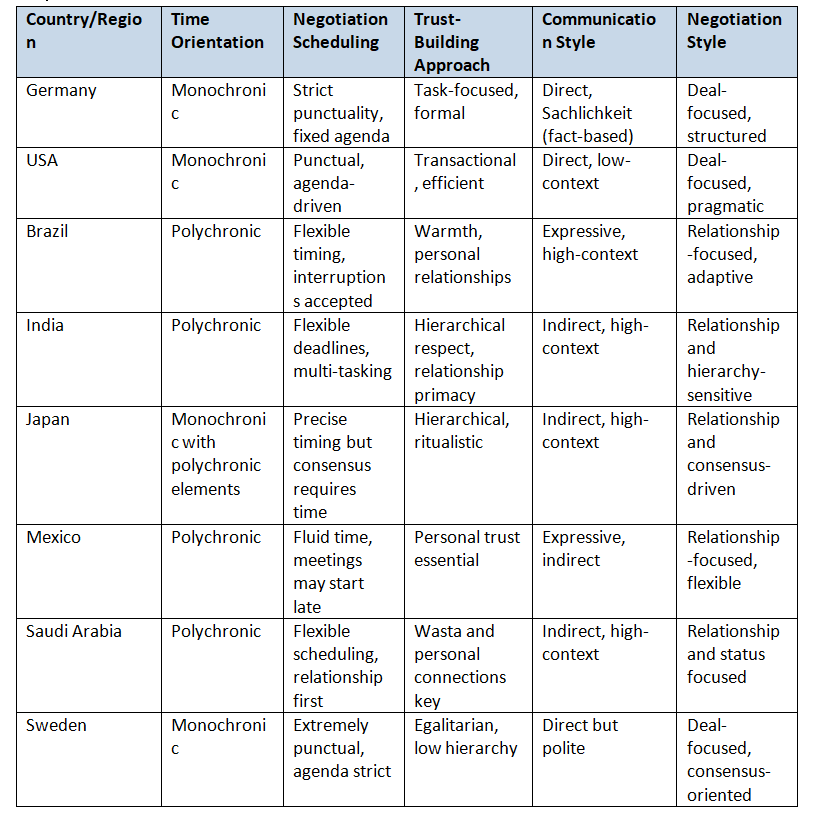
Country/Region-Specific Insights — Time-Related Negotiation Norms
Advanced Strategies — Expert-Level Techniques for Managing Time Perception
· Develop a dynamic time-flexibility matrix for your negotiation team, categorizing counterparts by time orientation and tailoring agenda rigidity accordingly.
· Use cultural intelligence (CQ) debriefs after each meeting to recalibrate time expectations and negotiation pacing.
· Leverage local cultural intermediaries or “cultural brokers” who understand subtle time norms, e.g., Japanese nemawashi facilitators or Indian middle managers skilled in managing fluid deadlines.
· Prepare multi-modal communication plans combining formal scheduling with informal relationship-building sessions to satisfy both monochronic and polychronic preferences.
· Employ Thomas-Kilmann Conflict Mode Instrument culturally: monochronic cultures often adopt competing/assertive modes around time, whereas polychronic cultures prefer accommodating or collaborating modes to preserve relationships.
Scripts and Templates — Exact Language for Time-Sensitive Negotiations
Script 1: Initiating a Meeting with a Monochronic German Partner
“Good morning, we appreciate your punctuality and have prepared a detailed agenda to ensure efficient use of our time. We will begin promptly at 9:00 AM and aim to conclude by 11:30 AM. Please let us know if you have any time constraints.”
Script 2: Starting a Meeting with a Polychronic Brazilian Partner
“Olá, we’re delighted to have this opportunity to meet. We have some topics prepared but welcome a flexible discussion format. Please feel free to share your thoughts and take the time needed to explore all ideas.”
Script 3: Negotiating Deadlines with an Indian Partner
“We understand the importance of achieving our project milestones and propose the following timeline. However, we recognize that flexibility may be necessary to accommodate evolving needs and priorities. Let’s keep open communication to adjust as needed.”
Script 4: Managing Time Expectations with a Japanese Counterpart
“To respect your preference for thorough consensus building, we have allocated space within the agenda for detailed discussion and reflection. We look forward to your input and will adapt timing to ensure collective agreement.”
Script 5: Addressing Delays with a Middle Eastern Partner
“We value our partnership greatly and understand that timing can be fluid. Please inform us if scheduling changes are required so we can adjust plans accordingly and maintain smooth progress.”
Frequently Asked Questions
Q1: How do monochronic and polychronic time perceptions affect negotiation pacing?
Monochronic cultures prefer fast-paced, agenda-driven negotiations with clear start and end times. Polychronic cultures emphasize relationship-building and may allow interruptions or multitasking, resulting in slower, more fluid pacing.
Q2: What are effective ways to manage deadline expectations across time cultures?
Set deadlines clearly with monochronic partners; with polychronic partners, frame deadlines as goals rather than fixed points and maintain open communication for adjustments.
Q3: Can a culture be both monochronic and polychronic?
Yes. For example, Japan exhibits primarily monochronic scheduling but uses polychronic consensus-building processes (nemawashi), requiring nuanced adaptation.
Q4: How can I build trust when time perceptions differ significantly?
Prioritize relationship-building activities with polychronic cultures, be patient with flexible timing, and demonstrate respect for their temporal norms while clearly communicating your own preferences.
Q5: What are common pitfalls when negotiating across time cultures?
Insisting on rigid schedules with polychronic cultures, interpreting flexible timing as disrespect, or being late in monochronic cultures can damage trust and stall negotiations.
Conclusion
Time perception is a foundational, yet frequently underestimated, cultural dimension that profoundly shapes negotiation dynamics. Recognizing the monochronic versus polychronic divide—and its manifestations across cultures—empowers negotiators to design adaptable strategies that respect temporal preferences while advancing business objectives. By integrating theoretical insights with practical tools such as tailored scripts, stepwise approaches, and country-specific norms, global professionals can avoid costly missteps and build lasting partnerships.
Mastering time perception differences is not merely about punctuality or scheduling; it is about honoring divergent worldviews that frame how people value time, relationships, and tasks. When negotiators cultivate cultural intelligence and sensitivity toward these temporal nuances, they unlock smoother communication, deeper trust, and superior negotiated outcomes across the world’s diverse business landscapes. Begin implementing these frameworks today to elevate your cross-cultural negotiation effectiveness and achieve global success.
References
· Hall, E.T. (1959). The Silent Language. Doubleday.
· Hofstede, G. (2001). Culture’s Consequences: Comparing Values, Behaviors, Institutions and Organizations Across Nations. Sage Publications.
· Meyer, E. (2014). The Culture Map: Breaking Through the Invisible Boundaries of Global Business. PublicAffairs.
· Lewis, R.D. (2006). When Cultures Collide: Leading Across Cultures. Nicholas Brealey Publishing.
· Livermore, D.A. (2015). Leading with Cultural Intelligence: The Real Secret to Success. AMACOM.
· Trompenaars, F., & Hampden-Turner, C. (1998). Riding the Waves of Culture: Understanding Cultural Diversity in Business. Nicholas Brealey Publishing.