Time Pressure Tactics in Negotiation: How to Use and Resist Urgency

Negotiations often hinge on more than just the terms on the table; the clock itself becomes a powerful adversary or ally. Consider the 2018 NFL contract standoff between star quarterback Kirk Cousins and the Minnesota Vikings. The team’s front office imposed a ticking clock by setting an "exclusive negotiating window," pressuring Cousins to sign before free agency began. This time constraint aimed to force a quick decision, but instead, it backfired—Cousins held firm, leveraging the pressure to negotiate a more favorable deal elsewhere. This real-world example illustrates how time pressure tactics, when misapplied or resisted, can dramatically reshape negotiation outcomes.
At the neurological level, time pressure taps into the brain’s fear of loss and activates the amygdala—our emotional center responsible for quick, often irrational decisions under stress. Behavioral economists like Daniel Kahneman have shown that under time constraints, negotiators exhibit increased loss aversion and tend to make impulsive concessions. The scarcity principle, famously articulated by Robert Cialdini, also explains why urgency heightens perceived value and compels faster agreement. Understanding these psychological and behavioral underpinnings is crucial to wielding or resisting time pressure effectively.
This comprehensive guide will equip you to master time pressure tactics from every angle. You will learn how to deploy urgency strategically with step-by-step processes and precise scripts, how to identify when it’s being used against you, and how to counteract it confidently using proven behavioral science principles. Whether closing multimillion-dollar deals or managing labor union contracts, you’ll gain actionable insights to navigate the ticking clock with skill and composure.
· Table of Contents
· The Science Behind This Tactic
· How This Tactic Works in Practice
· Step-by-Step: How to Deploy This Tactic
· How to Recognize and Counter This Tactic
· Real-World Case Studies
· Common Mistakes When Using This Tactic
· Scripts and Templates
· Frequently Asked Questions
· Conclusion
· References
The Science Behind This Tactic
Time pressure tactics exploit deep cognitive biases and behavioral heuristics. Daniel Kahneman’s prospect theory (1979) reveals that people disproportionately weigh potential losses over equivalent gains, especially under stress. When a deadline looms, negotiators become loss-averse, fearing the opportunity slipping away, which often results in premature concessions.
The neuropsychology of decision-making under urgency highlights heightened amygdala activation and reduced activity in the prefrontal cortex—the area responsible for deliberate, analytical thinking. This neurological state triggers a shift from System 2 (slow, rational) to System 1 (fast, emotional) thinking, as described in Kahneman’s "Thinking, Fast and Slow" (2011). System 1’s susceptibility to framing effects and scarcity cues makes time pressure a potent psychological lever.
Robert Cialdini’s principle of scarcity (1984) complements this understanding. Scarcity increases perceived value and desirability, creating an urgency that compels accelerated action. In negotiation, scarcity often manifests as "limited time offers" or "last chance" ultimatums. This urgency invokes a reciprocal pressure to act swiftly, aligning with Cialdini’s reciprocity principle if combined with concessions or favors.
Chris Voss’s tactical empathy framework (2016) emphasizes recognizing and labeling the other party’s sense of urgency to defuse pressure and regain control. Voss argues that calibrated questions ("What about this deadline is critical for you?") can expose the negotiator behind the time pressure and open pathways for creative solutions.
Game theory also illuminates the strategic deployment of time pressure. In the prisoner's dilemma or Nash equilibrium scenarios, imposing a deadline shifts payoffs by increasing the cost of delay, potentially breaking deadlocks. However, irrational or overly aggressive use may trigger retaliation or negotiation breakdown.
Together, these psychological, neurological, and strategic insights explain why time pressure is a double-edged sword: it can accelerate agreement but risks costly mistakes or damaged relationships if mishandled.
How This Tactic Works in Practice
Time pressure in negotiation ranges from subtle nudges to overt ultimatums. At one extreme, a negotiator might casually mention a "tight timeline" to encourage faster decisions. At the other, they might set hard deadlines with explicit consequences for missing them. Variations include artificial deadlines, external constraints (regulatory filings, market windows), or social pressures (other bidders, team impatience).
The tactic works by compressing the decision window, inducing stress, and activating loss aversion and scarcity mindsets. This pressure often leads to two primary outcomes: accelerated agreement or breakdown due to resentment or resistance.
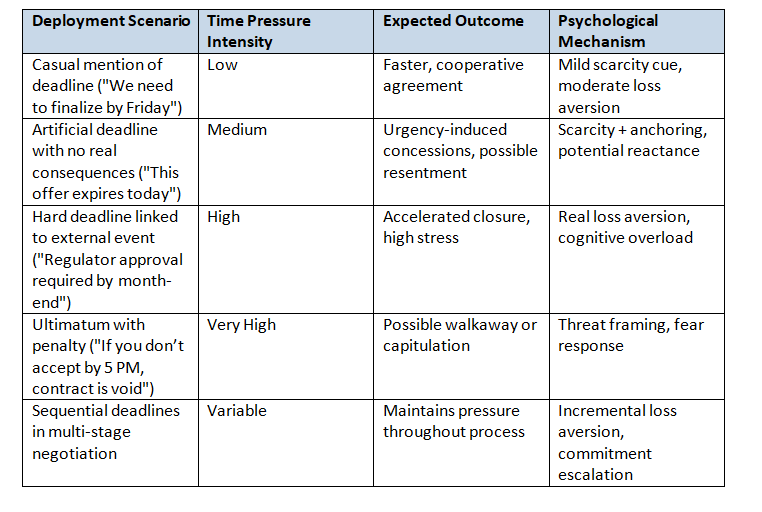
Real-world negotiators carefully calibrate time pressure intensity based on relationship, stakes, and opponent psychology. Overuse or misapplication risks eroding trust or provoking countermeasures.
Step-by-Step: How to Deploy This Tactic
Deploying time pressure effectively requires precision, empathy, and timing. Below is a detailed six-step process with psychological rationale and exact language guidance.
Step 1: Analyze Your Negotiation Context
Determine if a deadline or urgency is genuine or can be created artificially. Assess whether the other party values time-sensitive benefits or fears loss. Use Kahneman’s framing insights to anticipate their loss aversion threshold.
Step 2: Establish Your Objective and Leverage
Identify what deadline or scarcity can shift the negotiation equilibrium. For example, regulatory filing dates, competitor bids, or inventory limits. Use game theory to predict opponent reactions.
Step 3: Introduce the Time Constraint Subtly
Start with low-intensity cues: "We aim to finalize this week to meet project timelines." This plants the urgency seed without triggering resistance.
Step 4: Escalate Urgency with Calibrated Language
If pace stalls, increase emphasis: "To secure pricing, we need your decision by Friday." Avoid ultimatums initially; instead, use calibrated questions: "What challenges do you foresee meeting this timeline?"
Step 5: Anchor Expectations Around the Deadline
Frame the deadline as a positive opportunity rather than a threat: "Meeting this timeline will ensure the best terms and fastest implementation."
Step 6: Prepare for Pushback and Adjust
Monitor verbal and nonverbal cues signaling resistance. Use tactical empathy and labeling: "I sense this timeline feels tight; can you share what constraints you’re balancing?" Adjust pressure accordingly to maintain cooperation.
How to Recognize and Counter This Tactic
Recognizing time pressure tactics is critical to preserving negotiation power. Common signals include sudden deadline announcements, escalating urgency language, or creating artificial scarcity.
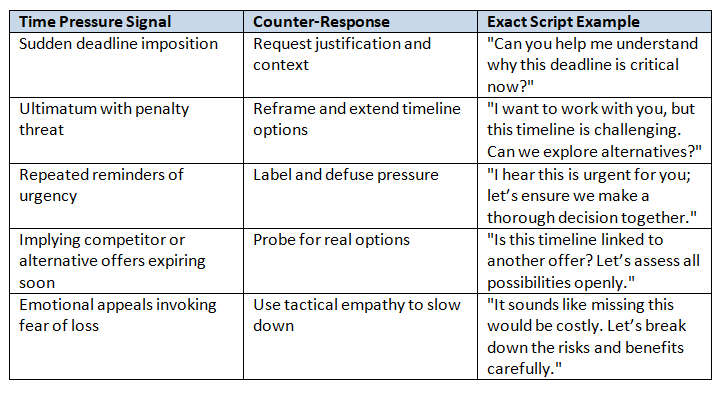
Countering effectively means slowing down the process, gathering information, and reframing urgency as a shared problem rather than a threat. This preserves rational decision-making and prevents reactive concessions.
Real-World Case Studies
Case Study 1: Apple vs. Samsung Patent Negotiations (2012)
During protracted litigation, Apple imposed a deadline on Samsung to settle or face escalating damages. Apple’s legal team used hard time pressure tied to upcoming product launches to force Samsung’s hand. However, Samsung resisted, using calibrated counters to extend timelines and renegotiate terms. The eventual settlement reflected a balance of urgency with strategic patience. Lesson: Excessive time pressure can backfire if the opponent is prepared.
Case Study 2: 2019 NBA Free Agency Contract Talks
Agents often use artificial deadlines during free agency to pressure teams. In one high-profile negotiation, an agent gave a "soft deadline" for a signing decision to create a bidding war. Teams recognized this tactic and countered by probing the urgency authenticity, ultimately delaying to improve terms. Lesson: Recognizing fabricated urgency preserves leverage.
Case Study 3: Colombian Hostage Negotiations (2007)
Hostage negotiators used real deadlines imposed by captors to manage release timing. Tactical empathy and calibrated questions were employed to buy time and reduce stress despite imminent threats. Lesson: In life-and-death scenarios, balancing urgency with emotional control is paramount.
Common Mistakes When Using This Tactic
Misapplying time pressure often leads to negotiation failure. Common errors include:
· Overuse of ultimatums, triggering reactance and walkaways
· Neglecting opponent’s capacity constraints, causing breakdowns
· Failing to prepare for counter-tactics, losing control
· Ignoring emotional signals, escalating conflict unnecessarily
· Using artificial deadlines transparently, reducing credibility
Fixes:
· Calibrate intensity and escalate gradually
· Combine pressure with empathy and open dialogue
· Build contingency plans for resistance
· Communicate deadlines as mutual opportunities
· Maintain flexibility to preserve relationships
Scripts and Templates
Script 1: Introducing Soft Deadline (Email)
"We are excited about moving forward and aim to finalize terms by Friday to align with our project schedule. Please let me know if this timeline works or if you foresee any challenges."
Script 2: Escalating Urgency (Phone)
"To ensure you benefit from current pricing, we’ll need your confirmation by end of day Thursday. What are your thoughts on meeting that timeline?"
Script 3: Countering Sudden Deadline (In-Person)
"I understand you mentioned a tight deadline just now. Can you share what’s driving this urgency so we can address it together?"
Script 4: Defusing Ultimatum (Email)
"I want to collaborate effectively and feel the current deadline is quite tight. Could we explore alternative timelines that work well for both parties?"
Script 5: Probing Artificial Scarcity (Phone)
"You mentioned this offer expires today. Is there flexibility on that date? I want to ensure we consider all factors before deciding."
Frequently Asked Questions
Q1: How can I tell if a time pressure tactic is genuine or manufactured?
A1: Genuine deadlines usually tie to external events (regulations, market windows). Ask for specifics and verification. Manufactured deadlines often rely on vague, shifting reasons.
Q2: What psychological effects make time pressure so effective?
A2: Time pressure triggers loss aversion, scarcity perception, and emotional decision-making by activating the amygdala and suppressing analytical thought.
Q3: How do I avoid making premature concessions under urgency?
A3: Use tactical empathy to acknowledge pressure, ask calibrated questions to gather info, and request reasonable extensions to preserve rationality.
Q4: Can time pressure damage long-term relationships?
A4: Yes, if perceived as manipulation. Combining urgency with respect and transparency mitigates relationship risks.
Q5: Are there industries where time pressure is especially effective or risky?
A5: Highly regulated industries (pharma, finance) often have real deadlines, making pressure effective. In public sector or creative fields, overuse risks backlash.
Conclusion
Mastering time pressure tactics equips negotiators with a powerful tool to accelerate agreements without sacrificing value or relationships. By understanding the psychological drivers—loss aversion, scarcity, emotional reactivity—you can deploy urgency with finesse, calibrate intensity, and use precise language to guide outcomes. Equally important is recognizing when time pressure is used against you and countering it methodically with empathy and probing techniques to maintain control.
In today’s fast-paced negotiation environments, your ability to wield and resist urgency can be a decisive competitive advantage. Begin integrating these evidence-based strategies and scripts into your negotiation playbook to negotiate with confidence under any deadline. For bespoke training and advanced tactical frameworks, connect with our expert consultancy today and transform how you manage the clock in every deal.
References
Fisher, R., Ury, W., & Patton, B. (2011). Getting to Yes: Negotiating Agreement Without Giving In. Penguin Books.
Kahneman, D. (2011). Thinking, Fast and Slow. Farrar, Straus and Giroux.
Cialdini, R. B. (1984). Influence: The Psychology of Persuasion. Harper Business.
Voss, C., & Raz, T. (2016). Never Split the Difference: Negotiating As If Your Life Depended On It. HarperBusiness.
Shell, R. (2006). Bargaining for Advantage: Negotiation Strategies for Reasonable People. Penguin.
Grant, A. (2013). Give and Take: Why Helping Others Drives Our Success. Penguin.
Taleb, N. N. (2007). The Black Swan: The Impact of the Highly Improbable. Random House.