Time Zone Challenges in International Negotiation: Strategies for Global Teams
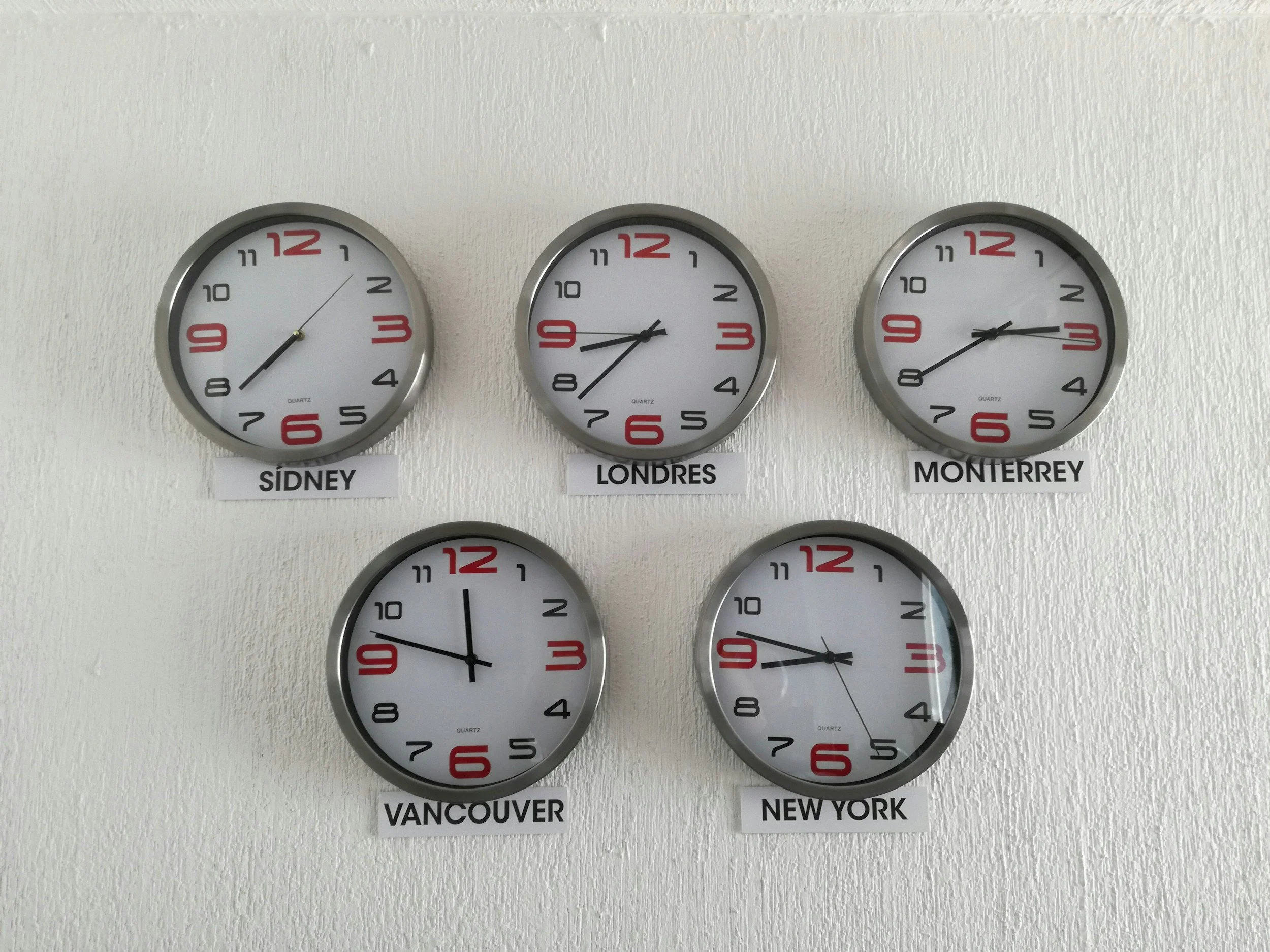
In 2018, a major international joint venture between a US-based tech giant and a South Korean electronics firm faltered unexpectedly. Despite years of preparation, the deal collapsed during final negotiations largely due to missed communications and scheduling conflicts across time zones. Critical decisions were delayed repeatedly, causing frustration and mistrust that eroded the partnership before it even began. This failure starkly illustrates how ignoring the complexities of coordinating across global time zones can derail even the most promising negotiations.
International negotiation fundamentally differs from domestic deals not only because of legal and linguistic complexities but also due to subtle cultural nuances and logistical challenges like time zone differences. Negotiators must navigate multiple layers — from Hofstede’s cultural dimensions influencing communication styles, to Hall’s concepts of monochronic versus polychronic time orientation — to build trust, manage expectations, and close deals effectively. Many professionals underestimate how these temporal and cultural factors interplay, leading to misunderstandings, stalled talks, or lost opportunities.
This comprehensive guide equips global business leaders, sales directors, diplomats, and procurement managers with actionable insights to master time zone challenges in international negotiations. You will learn to apply key cultural frameworks from Hofstede, Richard Lewis, and Erin Meyer, implement a step-by-step global negotiation strategy, analyze real-world case studies like US-China trade talks and EU-UK Brexit negotiations, and utilize tested scripts and templates tailored to cross-time-zone communication. By the end, you will possess practical tools to synchronize your global teams, respect cultural temporalities, and close deals confidently despite geographical distance.
· Table of Contents
· The Foundations of International Negotiation: Cultural & Structural Factors
· Key Frameworks and Cultural Models: Hofstede, Lewis, Meyer Comparisons
· Step-by-Step Strategy for Managing Time Zones in Negotiation
· Real-World Case Studies: US-China, EU-UK, Japan-US Negotiations
· Country-Specific Negotiation Insights & Time Zone Tactics Table
· Advanced Strategies: Navigating Hierarchy, Face, Relationships, Interpreters
· Scripts and Templates for Cross-Time-Zone Communication
· Frequently Asked Questions on Time Zone Challenges in Negotiations
· Conclusion and Strategic Call to Action
· References and Authoritative Sources
The Foundations of International Negotiation
International negotiation involves far more than transactional bargaining. Cultural psychology, communication styles, and organizational structures intertwine to create a complex environment. Geert Hofstede’s seminal research reveals how six cultural dimensions shape negotiation dynamics: power distance, individualism versus collectivism, uncertainty avoidance, long-term orientation, masculinity versus femininity, and indulgence versus restraint. For example, a high power distance culture such as South Korea expects formal deference to hierarchy, which affects who negotiates and when decisions are made.
Richard Lewis’s model categorizes cultures as Linear-Active (task-oriented, direct), Multi-Active (relationship-driven, flexible with time), and Reactive (respectful, indirect, polychronic). This model helps explain why a German negotiator (Linear-Active) may clash with a Brazilian counterpart (Multi-Active) over scheduling priority and deadlines. Edward Hall’s concept of monochronic versus polychronic time further clarifies this: monochronic cultures (e.g., USA, Germany) prefer punctuality and segmented schedules, whereas polychronic cultures (e.g., Middle East, Latin America) value relationship-building and multitasking over strict adherence to time.
Erin Meyer’s "The Culture Map" adds eight dimensions including Communication (low vs high context), Evaluating (direct vs indirect negative feedback), and Scheduling (linear vs flexible time), all critical when planning cross-time-zone negotiations. Failure to align on temporal expectations can lead to breakdowns in trust and cooperation before substantive issues are even discussed. Understanding these foundational cultural and structural factors is essential for global teams to design negotiation processes that respect multiple temporalities and avoid the pitfalls of asynchronous communication.
Key Frameworks and Cultural Models
This section highlights three key frameworks—Hofstede’s Dimensions, Richard Lewis’s Cultural Types, and Erin Meyer’s Culture Map—to understand how culture and time orientation affect international negotiations.
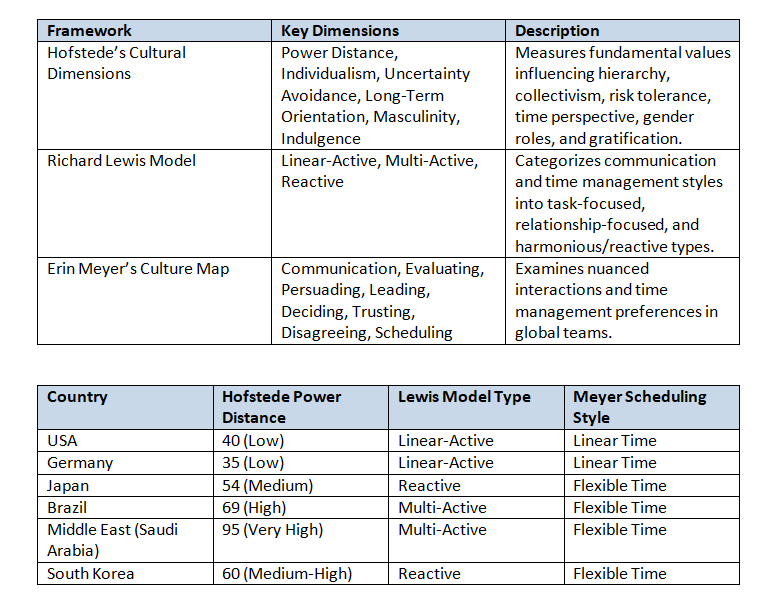
These frameworks help anticipate how different negotiating partners perceive time, deadlines, and scheduling, enabling tailored strategies that reduce friction caused by time zone differences.
Step-by-Step Strategy
Effectively managing time zone challenges in international negotiation requires a systematic approach integrating cultural intelligence and logistical planning.
Step 1: Comprehensive Cultural and Time Zone Mapping
Before scheduling any calls or meetings, map all participants’ time zones, working hours, holidays, and cultural time norms. Integrate this with Hofstede’s and Lewis’s cultural profiles to anticipate potential friction points.
Step 2: Set Clear, Shared Expectations on Timing and Communication
Use Erin Meyer’s scheduling dimension to clarify preferences upfront — agree on response times, meeting punctuality, and preferred communication channels (e.g., email vs video calls).
Step 3: Employ Rotational Meeting Times
To maintain fairness and goodwill, rotate meeting times so no party consistently bears the burden of inconvenient hours. This respects multi-active and reactive cultures’ emphasis on relationship-building.
Step 4: Leverage Asynchronous Communication Tools
Use shared platforms (Slack, MS Teams, collaborative documents) for information exchange to overcome time zone delays, allowing thoughtful responses outside synchronous meetings.
Step 5: Adapt Negotiation Scripts and Protocols by Culture and Time Zone
Customize opening remarks, agenda-setting, and closing statements to fit cultural expectations regarding formality, directness, and timing. Include explicit phrases to acknowledge different time zones and express flexibility.
Step 6: Schedule Buffer Time for Follow-Up and Decision-Making
Allow additional days for internal alignment and approvals, especially in high power distance or polychronic cultures where consensus and hierarchy slow decision-making.
Real-World Case Studies
US-China Trade Negotiations (2018-2020)
These prolonged talks highlighted how time zone challenges complicated direct communication. The US operates on Eastern or Pacific time, while China’s Beijing time is 12-15 hours ahead depending on the US location. Negotiators used rotational call times and relied heavily on asynchronous document exchanges to maintain momentum. However, differing cultural perceptions of punctuality and decision speed led to frustration on both sides. The solution involved appointing bilingual intermediaries who synchronized communication and contextualized delays.
EU-UK Brexit Talks (2016-2020)
Negotiators across multiple European time zones (GMT, CET, BST) faced difficulties coordinating plenary sessions and bilateral meetings. The UK’s more linear time orientation clashed with some EU countries’ flexible schedules. By employing strict scheduling procedures, clearly communicated agendas, and a shared digital platform for document review, the teams mitigated time zone friction. The use of multilingual teams with cultural training also enhanced understanding of different temporal expectations.
Japan-US Technology Partnership
In this deal, the US team initially struggled with Japan’s preference for consensus-building (nemawashi), which extended timelines. The US’s monochronic and direct communication style led to misinterpretation of delays as indecisiveness. Recognizing this, the US negotiators adjusted their expectations, scheduled meetings during overlapping working hours with buffer days, and adapted communication to be more indirect and relationship-focused, resulting in a successful agreement.
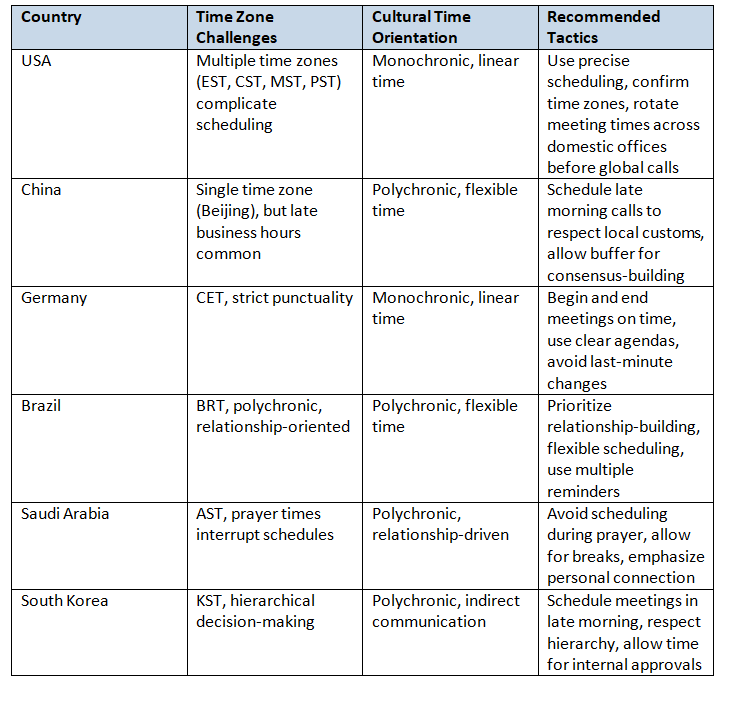
Country-Specific Negotiation Insights and Time Zone Tactics
Advanced Strategies
Global negotiation requires masterful management of complex cultural and temporal variables beyond basic scheduling.
· Managing Interpreters Effectively: Interpreters add time; schedule extra time blocks and use pre-briefings to ensure clarity and efficiency.
· Building Guanxi, Wasta, and Other Relationship Networks: Allocate time for informal conversations, even across time zones, using virtual coffee chats or after-hours messaging, respecting cultural preferences.
· Navigating Hierarchy: In high power distance cultures, recognize decision makers may need extra time; schedule follow-ups considering their availability.
· Handling Face-Saving: Polychronic cultures may delay responses to avoid direct refusals; use indirect inquiry scripts and allow time for reflection.
· Managing Time Differently: Employ Erin Meyer’s scheduling insights to blend linear and flexible approaches, using project management tools with shared deadlines to synchronize efforts.
Scripts and Templates
Script 1: Scheduling an Initial Meeting Across Multiple Time Zones (Formal, Linear-Active Culture)
Dear [Name],
I hope this message finds you well. To initiate our negotiation discussions, could we schedule a meeting at a mutually convenient time? Please let me know your available windows in your local time zone, and I will coordinate accordingly to accommodate all parties.
Looking forward to your reply.
Best regards,
Script 2: Acknowledging Time Zone Differences and Expressing Flexibility (Relationship-Oriented Culture)
Dear [Name],
Understanding the challenges posed by our differing time zones, I want to assure you that I am flexible with meeting times to best suit your schedule. Please feel free to suggest times that work well for you, and I will do my best to accommodate.
Warm regards,
Script 3: Follow-Up Email After Delayed Response (Indirect Communication Culture)
Dear [Name],
I hope you are doing well. I wanted to gently follow up on my previous message regarding our negotiation schedule. I understand that you may be busy, and I am happy to adjust timelines as needed to fit your availability.
Please let me know how you wish to proceed.
Kind regards,
Script 4: Confirming Meeting Time with Rotated Schedule (Multi-Active Culture)
Dear [Name],
Thank you for your input on scheduling. To be fair to all parties, we propose rotating meeting times so the inconvenience is shared equally. Our next meeting is planned for [date/time], which we hope works for you.
Please confirm or suggest alternatives.
Best wishes,
Script 5: Virtual Meeting Opening Remarks Addressing Time Zone Challenges
Good [morning/afternoon/evening], everyone. I appreciate your flexibility in joining this call across multiple time zones. We recognize the challenges this poses and are committed to keeping the discussion focused and efficient. Please feel free to speak up if timing issues arise so we can adjust as needed.
Thank you all for your participation.
Frequently Asked Questions
1. What are the main time zone challenges in international negotiation?
Time zone differences can cause scheduling conflicts, communication delays, fatigue from inconvenient meeting times, and misunderstandings about response deadlines. These challenges are often compounded by cultural differences in time orientation and communication styles.
2. How can negotiators effectively manage asynchronous communication?
By using shared digital platforms for document collaboration, setting clear expectations about response times, and summarizing discussions in writing, negotiators can maintain momentum despite time delays.
3. How do cultural attitudes toward time affect negotiation outcomes?
Cultures with monochronic time value punctuality and strict scheduling, while polychronic cultures prioritize relationships and flexibility. Misaligned expectations can lead to frustration or perceived disrespect.
4. What strategies help build trust when meetings occur at inconvenient hours?
Rotating meeting times, acknowledging the inconvenience explicitly in communications, and offering flexibility in scheduling demonstrate respect and build goodwill.
5. Are there specific tools recommended for managing cross-time-zone negotiations?
Tools like World Time Buddy for scheduling, Microsoft Teams or Slack for communication, and cloud-based project management software (Asana, Trello) help synchronize teams and reduce time-zone friction.
Conclusion
Time zone challenges in international negotiation are more than logistical hurdles; they are complex cultural phenomena that influence trust, communication, and decision-making. By integrating cultural intelligence frameworks like Hofstede’s dimensions, Lewis’s cultural types, and Meyer’s Culture Map with pragmatic scheduling strategies and tailored communication scripts, global teams can transform time zone obstacles into strategic advantages.
Negotiators who master these insights will not only avoid costly misunderstandings but will also deepen relationships and accelerate deal closure despite geographical dispersion. We invite you to apply these comprehensive strategies in your next negotiation and join the ranks of global leaders who thrive in the complex, dynamic world of international business.