Top Negotiation Skills You Need in Business
Negotiation is an indispensable skill in the modern business landscape. Whether you are closing a high-stakes deal, managing supplier contracts, or navigating internal conflicts, your ability to negotiate effectively can determine the success or failure of your objectives. As markets become more interconnected and competition intensifies, mastering negotiation goes beyond persuasion—it requires psychological insight, strategic preparation, and interpersonal finesse.
In today’s fast-paced and complex business environment, negotiation skills are critical for leaders, sales professionals, and managers alike. The ability to find mutually beneficial solutions, maintain relationships, and anticipate counteroffers can transform potential conflicts into opportunities for growth. This article will provide a comprehensive guide to the top negotiation skills you need in business, grounded in research and enriched with real-world examples and exercises.
You will learn how to harness key psychological principles like BATNA (Best Alternative to a Negotiated Agreement), anchoring, mirroring, and active listening. Additionally, you will discover practical frameworks and actionable strategies to apply these skills immediately. By building these competencies, you will enhance your confidence, influence, and outcomes in any negotiation scenario.
· Table of Contents
· Understanding the Foundation: Preparation and BATNA
· Active Listening and Empathy: The Core of Rapport Building
· Mastering Persuasion Techniques: Anchoring and Framing
· Nonverbal Communication and Mirroring in Negotiations
· Managing Emotions and Conflict Resolution
· Closing Strategies and Creating Win-Win Outcomes
· Frequently Asked Questions
· Conclusion
· References
Understanding the Foundation: Preparation and BATNA
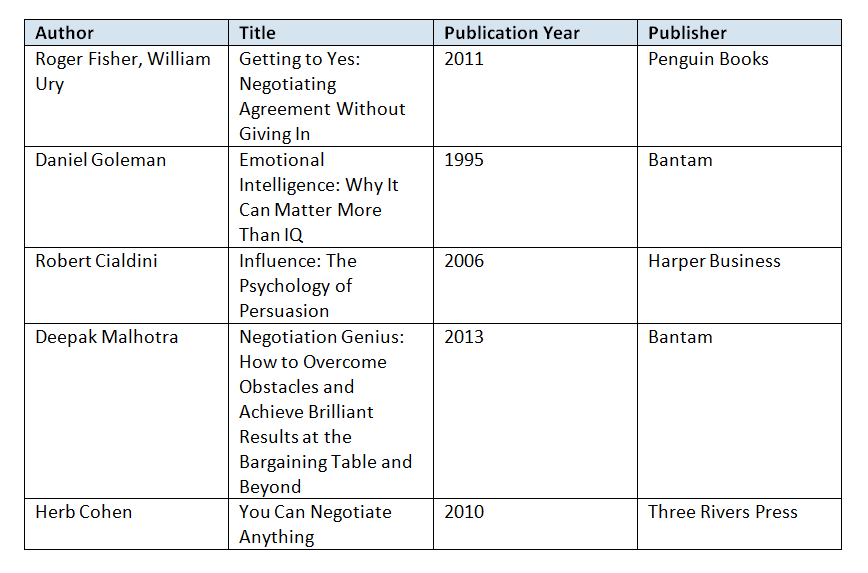
Effective negotiation begins long before the conversation starts. Preparation is arguably the most important skill in any negotiation setting. It involves gathering information, anticipating the other party’s needs and constraints, and clearly defining your own goals and limits. A critical element of preparation is understanding your BATNA—Best Alternative to a Negotiated Agreement—a concept popularized by Roger Fisher and William Ury in "Getting to Yes."
1. List all alternatives if the current negotiation fails.
2. Evaluate the value and feasibility of each alternative.
3. Identify your strongest alternative and quantify its value.
4. Use this knowledge to establish your negotiation threshold.
For example, when Apple negotiated with suppliers for iPhone components, they often leveraged their BATNA by having multiple suppliers ready. This reduced dependency and increased their bargaining power, leading to better pricing and terms.
Preparation also involves research on the other party’s interests, cultural norms, and decision-making style. The Harvard Negotiation Project emphasizes separating people from the problem, which requires understanding the perspectives and emotions involved.
Application Tips
· Create a detailed negotiation plan outlining objectives, concessions, and desired outcomes
· Practice role-playing to anticipate counterarguments and rehearse responses
· Identify decision-makers and influencers on the other side to tailor your approach
Active Listening and Empathy: The Core of Rapport Building
Active listening is a psychological skill that fosters trust and openness, essential for successful negotiations. It involves fully concentrating on the speaker, understanding their message, responding thoughtfully, and remembering key points. Empathy complements active listening by allowing you to perceive and validate the emotions and motivations behind the words.
The theory of emotional intelligence , developed by Daniel Goleman, highlights the importance of empathy in interpersonal interactions. Negotiators with high emotional intelligence can read subtle cues and adapt their approach accordingly, resulting in stronger relationships and better outcomes.
During contract negotiations between a multinational corporation and a local vendor in Latin America, the lead negotiator used active listening to uncover the vendor’s concerns about payment terms and cash flow. By acknowledging these issues empathetically, they structured a payment plan that met both parties’ needs, leading to a long-term partnership.
Practical Exercises to Build Active Listening
· Paraphrase what the other party says to confirm understanding
· Use open-ended questions to encourage elaboration (e.g., "Can you tell me more about your priorities?")
· Observe tone and body language to detect unspoken concerns
Mastering Persuasion Techniques: Anchoring and Framing
Persuasion is central to negotiation success. Two pivotal techniques are anchoring and framing, both grounded in cognitive psychology and behavioral economics.
For instance, a real estate agent listing a property at a high price sets an anchor that shapes buyers’ expectations. However, it must be realistic to maintain credibility.
Persuasion Scripts and Techniques
· Start with an ambitious but reasonable anchor to leave room for concessions
· Frame offers in terms of value and problem-solving rather than just price
· Use contrast by presenting a less attractive option first, then the desired proposal
Nonverbal Communication and Mirroring in Negotiations
Nonverbal cues constitute a significant portion of communication and can either strengthen or undermine your negotiation position. Mirroring—subtly mimicking the other party’s body language, tone, or speech patterns—can build rapport and increase trust.
Research by psychologist Albert Mehrabian suggests that up to 55% of communication impact is nonverbal, emphasizing the importance of gestures, facial expressions, and posture.
· Match the other person’s pace of speech and volume
· Reflect their body posture and gestures naturally
· Use similar vocabulary or expressions when appropriate
A case study from the FBI’s hostage negotiation unit demonstrates how mirroring helps build unconscious rapport, encouraging cooperation and de-escalation.
Practical Nonverbal Skills
· Maintain appropriate eye contact to show engagement without intimidation
· Use open body language to appear approachable
· Be mindful of cultural differences in nonverbal communication
Managing Emotions and Conflict Resolution
Negotiations often become tense, especially when stakes are high or interests conflict. Managing emotions—both yours and the other party’s—is critical to maintaining constructive dialogue.
The Dual Concern Model in negotiation theory highlights balancing concern for self and concern for others. Being too competitive can damage relationships; being too accommodating can leave value on the table.
· Use "I" statements to express concerns without blaming (e.g., "I feel concerned about the delivery timeline.")
· Take breaks if discussions become heated to allow cooling off
· Reframe negative comments into problem-solving language
Real-world negotiators use mindfulness and breathing techniques to stay calm, as documented in research from the University of California on stress reduction in negotiations.
Conflict Resolution Strategies
· Identify common interests to shift focus away from positions
· Use integrative negotiation to create value rather than compete over fixed resources
· Employ third-party mediation when deadlocks occur
Closing Strategies and Creating Win-Win Outcomes
The final phase of negotiation—closing the deal—requires clarity, confidence, and precision. Closing strategies should aim to solidify agreement while preserving the relationship.
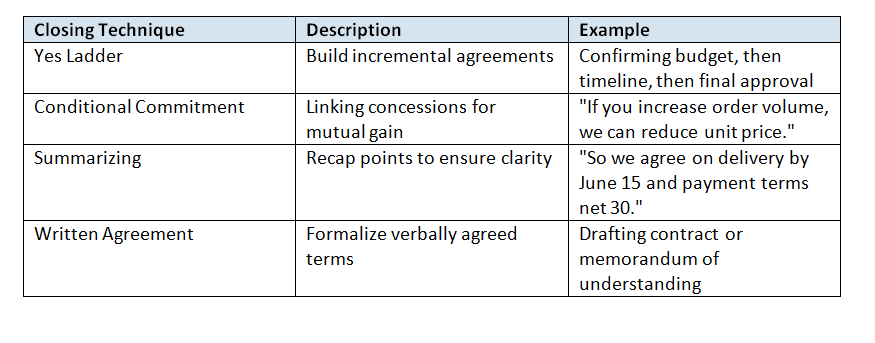
One approach is the "Yes Ladder" , a technique that involves getting a series of small agreements before asking for the final commitment. This builds momentum and reduces resistance.
Practical Closing Techniques
· Summarize agreed points clearly to avoid misunderstandings
· Use conditional commitments (e.g., "If you agree to X, then I can commit to Y.")
· Prepare written agreements promptly to formalize commitments
Frequently Asked Questions
What is the most important negotiation skill in business?
The most vital skill is thorough preparation, including understanding your BATNA. Being well-prepared allows you to negotiate confidently, set realistic goals, and avoid accepting unfavorable terms. Preparation also includes researching the other party and anticipating challenges.
How can I improve active listening during negotiations?
Improve active listening by focusing fully on the speaker, avoiding interruptions, paraphrasing their points, and asking open-ended questions. Practicing mindfulness and reducing distractions also enhance your ability to listen deeply and respond appropriately.
What role does emotional intelligence play in negotiation?
Emotional intelligence helps negotiators recognize and manage their own emotions and those of others. High emotional intelligence reduces conflict, builds rapport, and improves decision-making under pressure, leading to more effective and collaborative negotiations.
How do I handle a difficult or aggressive negotiator?
Stay calm, use active listening to understand their concerns, and avoid responding emotionally. Employ techniques like reframing, taking breaks, and redirecting the conversation toward interests rather than positions. If necessary, consider involving a neutral third party.
Can negotiation always result in a win-win outcome?
While win-win outcomes are ideal and often achievable with integrative negotiation techniques, some situations may require compromise or assertive stances. The goal is to maximize mutual value whenever possible while protecting your interests and maintaining relationships.
Conclusion
Mastering negotiation skills is essential for thriving in today’s competitive business world. From preparation and BATNA analysis to active listening, persuasion, and managing emotions, each skill builds on the other to create a powerful negotiation toolkit. Applying these techniques will not only improve your ability to close deals but also enhance your relationships and reputation in the marketplace.
Start integrating these negotiation skills into your daily business interactions by practicing the exercises and frameworks outlined in this article. The more you refine your approach, the greater your influence and success will be. Take control of your negotiations today—equip yourself to create value, resolve conflicts, and achieve sustainable agreements.