Trust Building Across Cultures: How to Establish Credibility in International Negotiations
In 2015, a major technology partnership between a leading German automotive supplier and a Chinese manufacturer collapsed just weeks before signing. Despite months of talks, the German negotiators perceived the Chinese counterparts as evasive, while the Chinese delegation felt disrespected by the German’s blunt communication style and insistence on contractual details early on. What neither side fully realized was that their differing cultural expectations around trust, communication, and relationship-building created an invisible barrier. This misunderstanding cost both companies tens of millions in lost revenue and a multi-year competitive advantage.
Cross-cultural negotiation is fundamentally different from domestic deals because it operates on multiple layers of communication and unspoken cultural scripts. Assumptions that feel natural in one culture—such as directness or quick decision-making—can be signals of disrespect or mistrust in another. Trust is not simply given; it must be cultivated through culturally appropriate behaviors, timing, and communication styles. Without trust, no amount of technical expertise or financial incentive can close the deal.
This article will equip you with deep expertise to navigate these complexities. You will master seminal cultural frameworks including Hofstede’s dimensions, Erin Meyer’s Culture Map, Richard Lewis’s communication styles, Edward Hall’s context and time theories, and David Livermore’s Cultural Intelligence (CQ). You will gain country-specific insights from Japan’s nemawashi to Brazil’s jeitinho, actionable preparation steps, exact scripts adapted to multiple cultures, and expert strategies to read non-verbal cues and manage interpreters. This definitive guide is designed for executives, diplomats, and global sales leaders determined to build trust and close deals worldwide.
· Table of Contents
· The Science of Cultural Differences in Negotiation
· Key Cultural Frameworks and Country Comparisons
· Step-by-Step Cultural Preparation Strategy
· Real-World Case Studies in Cross-Cultural Trust Building
· Country/Region-Specific Insights: Do’s and Don’ts
· Advanced Strategies for Expert-Level Cross-Cultural Negotiation
· Scripts and Templates: Language and Tone Adaptations
· Frequently Asked Questions
· Conclusion: Synthesizing Key Insights and Next Steps
· References
The Science of Cultural Differences in Negotiation
Understanding trust building across cultures begins with grasping the foundational cultural dimensions that shape negotiation behaviors, communication styles, and relationship dynamics. Scholars over decades have developed models that quantify and categorize cultural traits. Below is an overview of seven key researchers and their frameworks, with specific country examples illustrating how these dimensions impact negotiation.
Geert Hofstede's Six Dimensions of National Culture are widely regarded for quantifying cultural values:
- Power Distance Index (PDI): Degree to which less powerful members expect unequal power distribution. For example, India scores 77 (high), indicating acceptance of hierarchy, whereas Denmark scores 18 (low), reflecting egalitarianism.
- Individualism vs Collectivism (IDV): The extent individuals look after themselves vs group loyalty. The US scores 91 (high individualism), China scores 20 (collectivist).
- Masculinity vs Femininity (MAS): Preference for achievement and competitiveness vs cooperation and care. Japan scores 95 (masculine), Sweden 5 (feminine).
- Uncertainty Avoidance Index (UAI): Comfort with ambiguity and risk. Greece scores 112 (high), Singapore 8 (low).
- Long-Term Orientation (LTO): Focus on future rewards vs tradition. China scores 87 (long-term), Russia 81.
- Indulgence vs Restraint (IVR): Enjoyment of life and leisure. Mexico scores 97 (indulgent), Japan 42.
Erin Meyer’s Culture Map expands on communication and trust nuances using eight dimensions:
- Communicating: Low-context (direct) vs high-context (indirect). Germany is low-context, Japan high-context.
- Evaluating: Direct negative feedback (Israel) vs indirect (Japan).
- Persuading: Principles-first reasoning (France) vs applications-first (US).
- Leading: Egalitarian (Scandinavia) vs hierarchical (India).
- Deciding: Consensual (Japan’s ringi system) vs top-down (Russia).
- Trusting: Task-based (US) vs relationship-based (China).
- Disagreeing: Confrontational (Israel) vs avoids confrontation (Korea).
- Scheduling: Linear time (Germany) vs flexible time (Brazil).
Richard Lewis’s model classifies cultures as Linear-Active (Germany), Multi-Active (Mexico), or Reactive (Japan), which impact negotiation pacing and style.
Edward Hall’s theories focus on high-context versus low-context communication, monochronic (one task/time) versus polychronic time management, and proxemics (space preferences). For instance, Middle Eastern cultures tend to be high-context and polychronic, favoring flexible scheduling and warm personal interactions.
Richard Gesteland identifies four dimensions relevant to negotiation:
- Deal-focus (US, Germany) vs relationship-focus (China, Saudi Arabia)
- Formal (Japan) vs informal (Australia)
- Rigid-time (Switzerland) vs fluid-time (India)
- Expressive (Italy) vs reserved (UK)
David Livermore’s Cultural Intelligence (CQ) framework emphasizes four capabilities essential for trust building:
- CQ Drive: motivation to adapt cross-culturally.
- CQ Knowledge: understanding norms and practices.
- CQ Strategy: planning and awareness during interaction.
- CQ Action: ability to modify behavior.
Trompenaars & Hampden-Turner's dimensions also highlight:
- Universalism vs Particularism: Rule-based (US) vs relationship-based exceptions (China).
- Individualism vs Communitarianism: Similar to Hofstede.
- Neutral vs Emotional: Reserved (UK) vs expressive (Mexico).
- Specific vs Diffuse: Separation of work and private life (Germany) vs intertwined (Arab countries).
- Achievement vs Ascription: Value based on performance (US) vs status or age (India).
These frameworks, combined, create a multidimensional understanding of how trust is perceived and built differently worldwide.
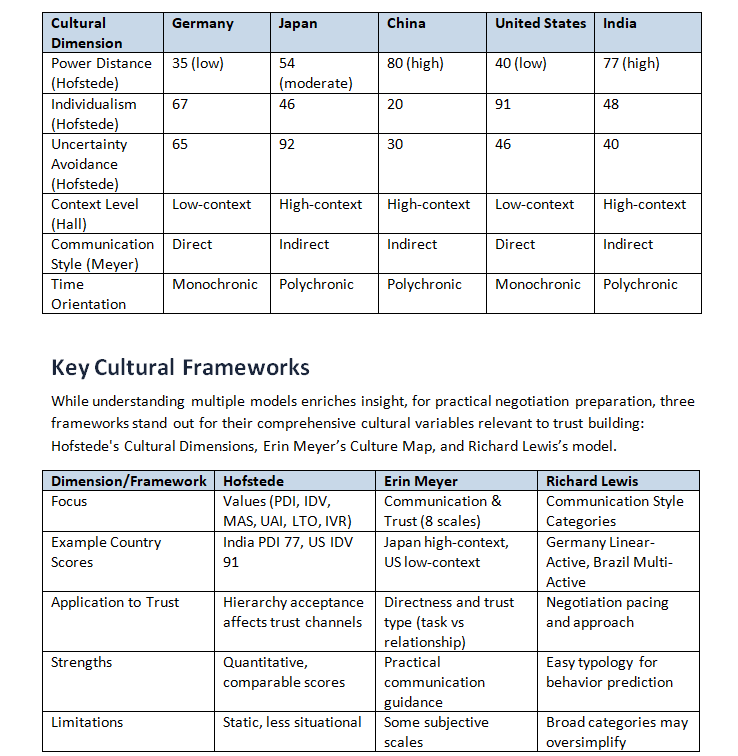
Combining these frameworks allows negotiators to plan interaction style, communication tone, and relationship-building efforts that are culturally congruent, enhancing credibility and fostering trust.
Step-by-Step Cultural Preparation Strategy
Mastering trust building in international negotiations requires deliberate, structured preparation. Below is a six-step strategy emphasizing cultural research, relationship-building, communication adaptation, and closing techniques.
Step 1: Conduct Deep Cultural Research
Before any engagement, gather detailed data on the counterpart’s culture using Hofstede’s scores, Meyer’s Culture Map profiles, and country-specific reports. Focus on hierarchy levels, communication style, time orientation, and trust-building norms.
Example: Prior to negotiating with Japanese partners, study the nemawashi process—informal consensus-building—so as to avoid rushing decisions publicly.
Step 2: Identify Relationship-Building Priorities
Determine if the culture is relationship- or deal-focused (Gesteland). In relationship-based cultures (China, Saudi Arabia), invest time in social meetings, exchanging gifts, and understanding guanxi or wasta networks.
Example: Brazilian negotiators expect warmth and personal friendliness (jeitinho) before discussing contracts.
Step 3: Adapt Communication Style
Adjust directness, feedback delivery, and language level per culture. Use Erin Meyer’s communicating and evaluating scales to tailor messages.
Example: German counterparts appreciate direct, fact-based communication, while Korean partners require reading nunchi (non-verbal cues) and indirect requests.
Step 4: Build Trust Through Appropriate Signals
Use culturally resonant trust signals—such as formality, punctuality, gift-giving, or face-saving tactics. Avoid behaviors that cause loss of mianzi (face) in China or disregard wasta in the Middle East.
Example: In Middle Eastern negotiations, demonstrating respect for hierarchy and engaging tribal or family networks deepens trust.
Step 5: Manage Conflict and Disagreement Mindfully
Recognize whether disagreement is confrontational (Israel) or avoided (Japan). Prepare to use indirect language or third-party intermediaries as needed.
Step 6: Close with Cultural Sensitivity
Timing and style of closing vary. In consensus-driven cultures like Japan, avoid pressuring a decision; in American contexts, clarity and urgency may be preferred.
Example: Use ringi system in Japan to circulate proposals for approval before final agreement.
Real-World Case Studies
Case Study 1: US–Chinese Tech Partnership Failure (2015)
Context: A US software company attempted rapid contract negotiation with a Chinese firm.
Dynamics: The US team was task-focused, pushing for fast signature; Chinese team emphasized relationship-building and guanxi.
Outcome: Chinese partners withdrew, citing lack of trust.
Lesson: Recognizing and respecting relationship-building timelines is critical.
Case Study 2: German–Brazilian Automotive Deal Success (2019)
Context: German executives adapted to Brazilian multi-active style, allowing flexible scheduling and informal socializing.
Dynamics: Brazilians valued warmth and personal connection (jeitinho); Germans brought structured agendas but softened directness.
Outcome: Deal closed with strong ongoing partnership.
Lesson: Adapting communication and investing time in relationship-building bridges cultural gaps.
Case Study 3: Japanese–French Joint Venture
Context: Japanese firm employed nemawashi consensus-building before formal French negotiation meetings.
Dynamics: French negotiators appreciated intellectual rigor but initially misread Japanese indirectness.
Outcome: Early misunderstandings resolved by intercultural coaching, leading to mutual trust.
Lesson: Awareness of cultural decision-making protocols prevents costly missteps.
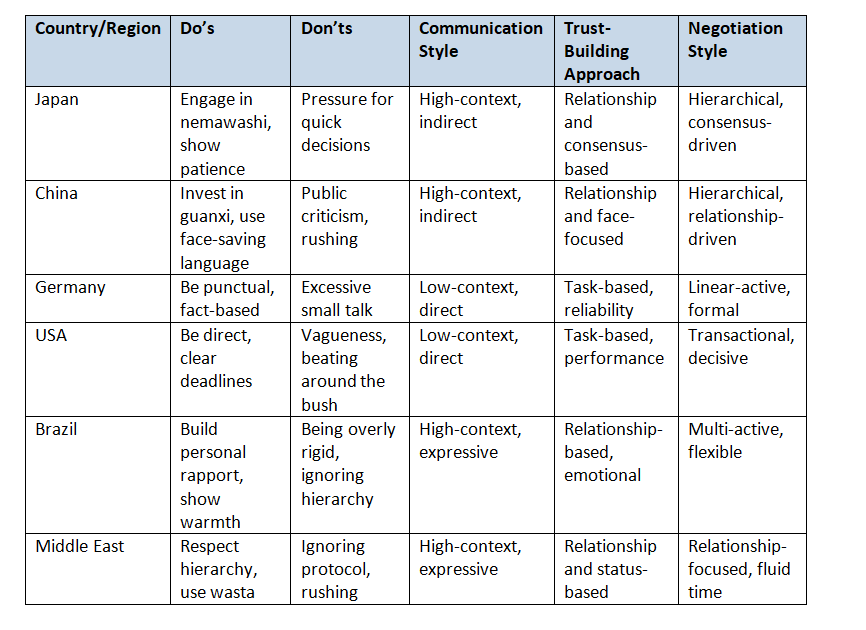
Country/Region-Specific Insights
Advanced Strategies
Managing Interpreters
Select interpreters experienced in business and culturally sensitive contexts. Brief them thoroughly. Use short sentences and pause frequently for accuracy. Maintain eye contact to build rapport despite language mediation.
Building Guanxi, Wasta, and Relationships
In China, guanxi involves reciprocal favors and trust networks; in the Middle East, wasta leverages family or tribal connections. Engage social networks, accept invitations, and reciprocate gestures respectfully.
Navigating Hierarchy and Face
Understand power distance; use titles and honorifics properly. Avoid causing loss of face by criticizing publicly. Use indirect language for negative feedback.
Adapting Persuasion Styles
Tailor arguments to cultural reasoning: French prefer principles-first logic; Americans expect applications-first. Use storytelling in cultures valuing emotional connection.
Reading Non-Verbal Signals
Monitor proxemics: personal space varies (closer in Latin America, more distance in Northern Europe). Note facial expressions, tone, and gestures to interpret implicit messages.
Scripts and Templates
Below are adaptations of a contract renewal request across four cultures illustrating tone and phrasing shifts.
Script 1: German (Direct, Formal)
“Dear Herr Müller,
Following our successful collaboration this past year, we propose to renew the contract effective July 1st. Attached are the updated terms reflecting our discussions. Please review and advise any concerns by next Monday to proceed efficiently.
Best regards,
Script 2: Japanese (Indirect, Polite)
“Dear Mr. Takahashi,
We deeply appreciate the continued partnership between our companies. Regarding the upcoming contract renewal scheduled around July, we humbly submit the attached draft for your kind consideration. We would be grateful for any suggestions you might share at your convenience.
Sincerely,
Script 3: Brazilian (Warm, Relationship-Focused)
“Olá Senhor Silva,
It has been a pleasure working together this past year. As July approaches, we would love to discuss renewing our contract and continue this great partnership. I have included a draft for you to look over, and I’m happy to meet anytime to talk through it.
Abraços,
Script 4: American (Direct, Task-Oriented)
“Hi John,
Hope all is well. I’m reaching out to confirm our interest in renewing the contract starting July 1. Please find attached the proposed terms. Let me know if you have feedback by Friday so we can finalize.
Thanks,
Frequently Asked Questions
Q1: How long does it typically take to build trust in cross-cultural negotiations?
A1: It varies greatly. Relationship-based cultures like China or Saudi Arabia may require months of socializing and small favors, while task-based cultures like the US or Germany often expect faster trust development based on competence and delivery.
Q2: How can I avoid causing loss of face during negotiations?
A2: Avoid public criticism, direct refusals, or confrontations. Use indirect language, private feedback, and emphasize positive intentions. Learn specific face-saving customs of the culture you are engaging with.
Q3: Should I always adapt my negotiation style to the other culture?
A3: Yes, adapting your style increases credibility and trust. However, retain core authenticity. Use CQ Strategy and CQ Action capabilities to balance adaptation with your negotiation goals.
Q4: What role do non-verbal cues play in trust building?
A4: Non-verbal cues like eye contact, gestures, silence, and physical distance convey respect, sincerity, or discomfort and vary by culture. Misreading them can damage trust.
Q5: How do hierarchical cultures affect decision-making speed?
A5: High power distance cultures often require approvals from senior leaders, slowing decisions. Understanding and respecting this prevents frustration and shows cultural intelligence.
Conclusion
Building trust across cultures is the linchpin of successful international negotiations. It requires more than transactional skill—it demands cultural intelligence, patience, and adaptive communication. By mastering frameworks like Hofstede’s dimensions, Meyer’s Culture Map, and Lewis’s communication styles, negotiators gain the insight to decode invisible cultural scripts. Applying structured preparation strategies and culturally tailored communication fosters credibility and mutual respect.
In today’s interconnected global economy, your ability to navigate cultural nuances directly impacts deal outcomes, partnership longevity, and competitive advantage. Use the country-specific insights, advanced strategies, and exact scripts provided here to elevate your cross-cultural negotiation expertise. Begin today by deepening your cultural knowledge and practicing adaptive trust-building behaviors to unlock global opportunities.
References
- Hofstede, G. (2001). Culture’s Consequences: Comparing Values, Behaviors, Institutions and Organizations Across Nations. Sage Publications.
- Meyer, E. (2014). The Culture Map: Breaking Through the Invisible Boundaries of Global Business. PublicAffairs.
- Lewis, R. D. (2006). When Cultures Collide: Leading Across Cultures. Nicholas Brealey Publishing.
- Hall, E. T. (1976). Beyond Culture. Anchor Books.
- Livermore, D. (2015). Leading with Cultural Intelligence: The Real Secret to Success. AMACOM.
- Trompenaars, F., & Hampden-Turner, C. (2012). Riding the Waves of Culture: Understanding Diversity in Global Business. Nicholas Brealey Publishing.
- Gesteland, R. R. (2012). Cross-Cultural Business Behavior: Marketing, Negotiating, Sourcing and Managing Across Cultures. Copenhagen Business School Press.
- Harvard Business Review. (2017). “How Cultural Differences Impact International Negotiations” by Jeanne Brett and Tetsushi Okamoto.