Turning Difficult Negotiations into Wins: A Strategic Guide
High-stakes difficult negotiations often unfold like a pressure cooker on the brink of explosion. Imagine a tense boardroom where a multi-billion-dollar merger hangs by a thread, the opposing CEOs locked in a standoff, each word potentially detonating the deal. Or picture an FBI hostage negotiation where every moment counts and a single misstep risks lives. These scenarios are emblematic of the challenges negotiators face daily: navigating emotional minefields, overcoming entrenched positions, and managing power dynamics under intense pressure.
What most negotiators fail to grasp is that the biggest obstacles rarely lie in the terms themselves but in the psychological and emotional currents swirling beneath the surface. Daniel Kahneman’s System 1 (fast, emotional) and System 2 (slow, rational) thinking explain why pressure triggers knee-jerk reactions rather than thoughtful responses. Chris Voss’s concept of tactical empathy underscores the profound power of understanding the other party’s feelings to break deadlocks. Meanwhile, William Ury’s “Going to the Balcony” technique teaches negotiators how to step back emotionally and maintain presence under fire. Without mastering these psychological elements, negotiators often spiral into conflict traps, ultimatums, or frozen stalemates.
This comprehensive guide will equip you to turn difficult negotiations into wins by mastering the psychology behind conflict, applying proven frameworks like Voss’s FBI method and Ury’s negotiation principles, and executing a step-by-step negotiation process infused with tactical empathy and emotional regulation. You will also gain access to real-world case studies, actionable scripts for high-conflict scenarios, and advanced techniques to handle the most stubborn impasses. By the end, you will have a playbook that transforms chaos into collaboration and conflict into creative solutions.
· Table of Contents
· The Psychology Behind This Challenge
· Key Frameworks and Models
· Step-by-Step Process for Difficult Negotiations
· Real-World Case Studies
· Recognizing and Countering Difficult Dynamics
· Advanced Techniques
· Scripts and Templates
· Frequently Asked Questions
· Conclusion
· References
The Psychology Behind This Challenge
Negotiations under stress engage deep psychological and neurological processes that often sabotage rational decision-making. The amygdala, the brain’s emotional alarm system, can hijack cognitive control in moments of perceived threat, triggering the classic fight-flight-freeze response. This emotional flooding, as described by John Gottman, impairs our ability to process information calmly and objectively, leading to impulsive or aggressive behaviors that stall or wreck negotiations.
Daniel Kahneman’s dual-process theory differentiates between System 1, the quick, automatic, emotion-driven mode, and System 2, the slow, deliberate, logical mode. High-pressure negotiations frequently push negotiators into System 1 thinking, where biases, heuristics, and emotional reactivity dominate. The challenge is to engage System 2 deliberately, slowing down the process and reintroducing rationality.
Chris Voss’s concept of tactical empathy involves consciously recognizing and vocalizing the other party’s emotions and perspectives to reduce defensiveness and build rapport. This approach is crucial because psychological research shows that people are more receptive to influence when they feel understood rather than judged.
Trust repair theory, developed by John Gottman and others, demonstrates that trust breaks down quickly under conflict but can be rebuilt systematically through acknowledgment, apology, and consistent trustworthy behavior. Ultimatum game research in behavioral economics reveals how perceived fairness, not just rational payoff, drives decision-making; parties often reject offers that seem unfair even at a cost to themselves, underscoring the need to manage perceptions of equity.
In sum, mastering difficult negotiations requires managing emotional responses (yours and theirs), shifting from reactive to reflective thinking, leveraging empathy to reduce conflict, and rebuilding trust when damaged. Without this psychological foundation, strategy and tactics alone are insufficient.
Key Frameworks and Models
Several frameworks have emerged from decades of research and field experience that provide robust guidance for managing difficult negotiations. Here, we outline three essential models:
1. Chris Voss’s FBI Negotiation Method: This approach centers on tactical empathy, calibrated questions, mirroring, labeling, and effective pauses to steer conversations under duress.
2. William Ury’s “Going to the Balcony” and “The Third Side”: Ury’s framework emphasizes emotional self-regulation ("going to the balcony" to gain perspective), collaborative problem-solving, and involving neutral parties to facilitate resolution.
3. Thomas-Kilmann Conflict Mode Instrument (TKI): This model categorizes conflict handling styles into competing, collaborating, compromising, avoiding, and accommodating, helping negotiators understand their default tendencies and adapt accordingly.
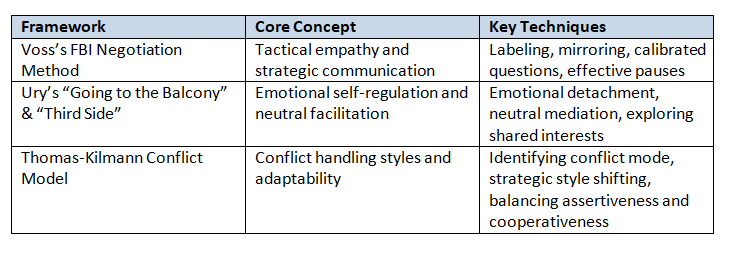
Understanding these frameworks is critical to selecting the right approach for each negotiation phase and conflict type.
Step-by-Step Process for Difficult Negotiations
Navigating a difficult negotiation successfully requires a structured process integrating psychological insight and tactical moves. Below is a detailed six-step process with embedded psychological techniques:
Step 1: Preparation and Emotional Calibration
Before entering the negotiation, conduct rigorous preparation, including:
- Researching the other party’s interests, constraints, and history.
- Engaging in Amy Cuddy’s power posing or breathing exercises to build presence and reduce stress.
- Forecasting emotional triggers and planning self-regulation techniques to avoid amygdala hijack.
Step 2: Establishing Rapport and Tactical Empathy
Open by demonstrating tactical empathy:
- Use Voss’s labeling: "It seems like this issue is really important to you."
- Mirror key words to build subconscious rapport.
- Validate emotions without agreeing to positions.
Step 3: Defining Interests and Framing the Negotiation
Shift conversation from positions to interests:
- Ask calibrated questions: “How can we solve this so both sides feel secure?”
- Identify underlying needs, fears, and values.
- Employ Ury’s “Going to the Balcony” mentally to stay objective.
Step 4: Managing Conflict Dynamics and Ultimatums
When faced with ultimatums or hard stances:
- Utilize Thomas-Kilmann styles to assess whether to compete or collaborate.
- Label emotional flooding: “I sense this is very frustrating for you.”
- Reframe ultimatums as problems to be solved together.
Step 5: Generating Options and Building Consensus
Encourage brainstorming:
- Use “Yes, and…” language to build on ideas.
- Invite the “Third Side” neutrals if impasse persists.
- Use incremental agreements to rebuild trust.
Step 6: Closing and Trust Repair
Seal the deal with:
- Clear summaries of agreements.
- Explicit trust repair moves—acknowledgment of past conflicts, sincere apologies if appropriate.
- Plan for follow-up and accountability.
This process integrates emotional intelligence, strategic communication, and structured problem solving to convert difficulty into opportunity.
Real-World Case Studies
FBI Hostage Negotiations: The 1993 Waco Siege
During the Waco standoff, FBI negotiators used tactical empathy and labeling to build rapport with David Koresh’s followers. However, failure to maintain emotional regulation and escalating tactical pressure led to a breakdown. The lesson: maintaining presence and patience is critical to avoid triggering fight-flight-freeze reactions that escalate conflict.
Corporate Boardroom Conflict: The AOL-Time Warner Merger 2000
This merger soured due to entrenched positions and lack of collaborative framing. Executives prioritized positional bargaining over shared interests, ignoring behavioral economics insights about fairness and trust repair. The breakdown illustrates the cost of neglecting psychological undercurrents.
Diplomatic Crisis: Cuban Missile Crisis 1962
Kennedy’s team used Ury’s “balcony” approach—stepping back emotionally to manage the crisis calmly. Through calibrated communication and third-party channels, they avoided nuclear war, demonstrating the power of emotional regulation and strategic empathy in life-or-death negotiations.
Recognizing and Countering Difficult Dynamics
Negotiations often feature recurring difficult behaviors. The table below maps common tactics to their psychological roots and precise countermeasures:
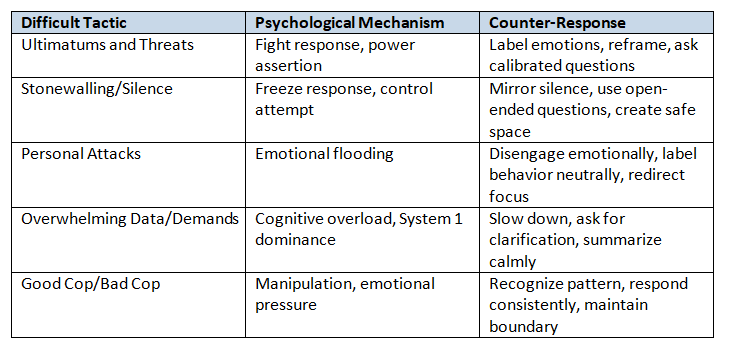
Awareness and precise responses neutralize these dynamics and preserve negotiation momentum.
Advanced Techniques
For seasoned negotiators, advanced methods deepen leverage and emotional control:
- Amy Cuddy’s presence under pressure: Use micro-expressions and body language to convey calm dominance and influence.
- Paul Ekman’s emotional tell analysis: Detect micro-expressions to identify concealed emotions and deception.
- Deliberate “mirroring” of vocal tone and pace to build unconscious rapport.
- Strategic use of “no-oriented” questions (“Is now a bad time to talk?”) to reduce resistance.
- Implementing “labeling” combined with calibrated questions to defuse tension and co-create solutions.
These techniques require practice but yield outsized returns in high-stakes contexts.
Scripts and Templates
Below are exact scripts for common difficult negotiation scenarios:
1. Responding to an Ultimatum:
“I hear that this is very important to you, and it seems like you feel this condition is non-negotiable. Can you help me understand what makes this point so critical for you?”
2. Defusing Personal Attacks:
“It sounds like this issue is really frustrating. I want to focus on solving the problem together rather than getting sidetracked.”
3. Handling Silence/Stonewalling:
“I’m sensing some hesitation—what’s on your mind right now?”
4. Navigating Overwhelming Data:
“That’s a lot of information to take in. Could you help me prioritize the key points so we can address them effectively?”
5. Redirecting Good Cop/Bad Cop:
“I appreciate that you’re trying to help us reach an agreement. Let’s make sure we’re clear on all points before moving forward.”
Frequently Asked Questions
Q1: How can I stay calm when negotiations become emotionally charged?
A1: Practice pre-negotiation emotional calibration using breathing exercises and visualization. During the negotiation, recognize signs of emotional flooding and use “going to the balcony” techniques to mentally step back. Amy Cuddy’s power poses and mindfulness can also enhance presence under pressure.
Q2: What if the other party refuses to engage in collaborative problem-solving?
A2: Use tactical empathy to understand their perspective and reduce defensiveness. Ask calibrated questions to invite participation and consider involving a neutral “third side” mediator to facilitate dialogue.
Q3: How do I rebuild trust after a negotiation breakdown?
A3: Follow Gottman’s trust repair model: acknowledge harm, offer a sincere apology, make amends, and demonstrate consistent trustworthy behavior over time. Transparency and patience are essential.
Q4: Can ultimatums ever be effective negotiation tactics?
A4: Ultimatums often backfire by triggering fight responses and reducing flexibility. They can work only if backed by credible consequences and when used sparingly. Generally, reframing ultimatums into joint problem-solving yields better outcomes.
Q5: How do I deal with manipulative tactics like Good Cop/Bad Cop?
A5: Recognize the pattern early, maintain consistent responses, and avoid emotional reactions. Use neutral labeling and refocus the conversation on substantive issues rather than personalities.
Conclusion
Mastering difficult negotiations is less about overpowering the other side and more about understanding and managing the complex psychological dynamics at play. By integrating neuroscience insights, tactical empathy, and proven frameworks like Voss’s FBI method and Ury’s emotional self-regulation, negotiators can transform conflict-laden encounters into productive dialogues that generate mutual value. The step-by-step process and real-world examples provided here serve as a blueprint for turning even the most entrenched stalemates into wins.
The true art of negotiation lies not in winning at all costs but in forging agreements that endure through trust, respect, and shared understanding. Armed with this strategic guide, you are now equipped to navigate the toughest negotiations with confidence and skill. Begin applying these techniques today and watch how difficult negotiations become your greatest opportunities for success.
References
1. Kahneman, D. (2011). Thinking, Fast and Slow. Farrar, Straus and Giroux.
2. Voss, C., & Raz, T. (2016). Never Split the Difference: Negotiating As If Your Life Depended On It. HarperBusiness.
3. Ury, W. (1991). Getting Past No: Negotiating in Difficult Situations. Bantam.
4. Gottman, J. M. (1994). What Predicts Divorce? The Relationship Between Marital Processes and Marital Outcomes. Lawrence Erlbaum Associates.
5. Cialdini, R. B. (2006). Influence: The Psychology of Persuasion. Harper Business.
6. Ekman, P. (2003). Emotions Revealed: Recognizing Faces and Feelings to Improve Communication and Emotional Life. Times Books.