Value-Based Pricing vs Price Negotiation: Which Wins?

Imagine this: A seasoned SaaS account executive is on a critical call with a Fortune 500 prospect. The client loves the product but abruptly says, “We need to talk about pricing. Can you offer a 20% discount?” The salesperson knows that conceding this discount risks eroding the company’s margin and establishes a dangerous precedent for future deals. Yet pushing back may endanger the deal entirely. This scenario plays out daily across industries—a battle between price negotiation and value-based pricing strategies that can make or break revenue goals.
This topic is critical for sales professionals and business owners alike because the cost of unnecessary discounting is staggering. According to SBI research, sales teams lose an average of 15-25% of potential revenue to discounting that could have been avoided with better pricing strategies. Beyond dollars, price shapes buyer perception. Behavioral economics illustrates how anchoring, loss aversion, and the price-quality heuristic influence decisions. Mismanaging price conversations undermines value, damages brand positioning, and compresses margins.
In this comprehensive guide, you will master the psychology behind price perception, learn key frameworks like the value ladder and BATNA for pricing decisions, and follow a step-by-step process to implement value-based pricing while managing negotiations. We will analyze real-world company examples, provide an objection handling matrix with precise scripts, uncover advanced tactics for senior sales pros, and deliver ready-to-use dialogue templates. By the end, you will confidently identify when value-based pricing wins, how to negotiate without discounting, and ultimately protect your premium pricing power.
· Table of Contents
· The Psychology of Price: Behavioral Economics Behind Buyer Perception
· Key Frameworks: Value Ladder, Price-Value Matrix, BATNA
· Step-by-Step Process for Implementing Value-Based Pricing and Managing Negotiation
· Real-World Examples: Apple, McKinsey, Salesforce
· Objection Handling: Price Objection Responses Matrix
· Advanced Tactics: Anchoring, Decoy Pricing, Scarcity, Reciprocity
· Scripts and Templates: Dialogue and Email Templates for Price Conversations
· Frequently Asked Questions: Long-Tail Query Answers
· Conclusion and Call to Action
· References
The Psychology of Price
Price perception is far from rational; it is deeply influenced by cognitive biases and behavioral economic principles. Understanding these forces equips sales professionals to design pricing strategies that resonate with buyers’ intrinsic decision-making processes.
Daniel Kahneman and Amos Tversky’s prospect theory (1979) explains that buyers do not evaluate price in absolute terms but relative to perceived gains and losses. Loss aversion means the pain of paying a price feels more intense than the pleasure of an equivalent gain. This is why discounts feel compelling but also why sudden price increases spark resistance. Salespeople can frame pricing as avoiding loss of value rather than a pure cost.
Research by Dan Ariely and others shows that buyers fixate on initial price anchors—even arbitrary ones. For example, when Apple introduced the original iPhone at $599, that price became the anchor against which all future models were judged. Clever pricing leverages anchors to set expectations high and make premium prices seem reasonable.
Many buyers equate higher price with higher quality or prestige (a manifestation of Veblen goods). This heuristic means premium pricing can itself create demand by signaling superior value. Undercutting price risks signaling inferior quality.
Introduced by behavioral economist Dan Ariely, the decoy effect occurs when the presence of a third option influences preference between two others. For instance, presenting a mid-tier priced product alongside a high-priced and low-priced option nudges customers toward the middle, perceived as the “best deal.” This tactic can be used to steer buyers away from discount demands.
Cialdini’s principles show that buyers respond to perceived generosity and limited availability. Offering small concessions early builds goodwill (reciprocity) but must be managed so it does not become expected. Scarcity of supply or exclusivity enhances willingness to pay.
This rich tapestry of psychological forces underscores why simplistic discounting undermines value. Instead, value-based pricing leverages these principles to justify premium pricing and reduce reliance on negotiation.
Key Frameworks
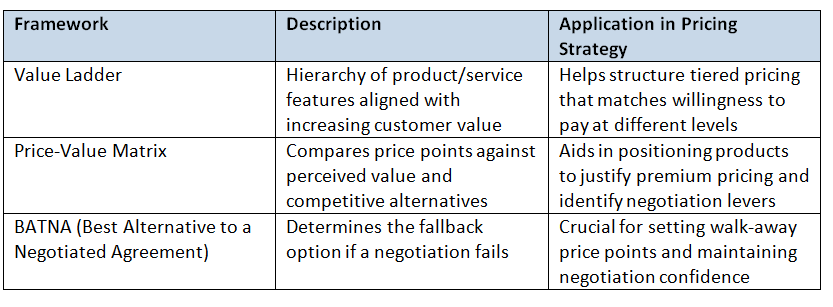
Several pricing and negotiation frameworks help sales teams systematically approach value-based pricing while managing negotiation dynamics. Below is a comparison of three essential frameworks.
Step-by-Step Process
Implementing value-based pricing while effectively managing price negotiation requires a disciplined, repeatable process. Below is a detailed six-step walkthrough.
Step 1: Deep Customer Value Discovery
Begin by conducting in-depth discovery to quantify the economic, operational, or strategic value your product or service delivers. Use open-ended questions to uncover pain points, current costs, and business outcomes. For example, ask: “Can you walk me through the current costs and inefficiencies you face?” or “What revenue impact would a 10% improvement in X yield?”
Document numeric data where possible to build a value case. This aligns with McKinsey’s value-based pricing approach, which prices according to the customer’s incremental profit or cost savings.
Step 2: Craft a Clear Value Narrative
Translate the quantified value into a compelling story that links features to outcomes. Avoid technical jargon; focus on business impact. Use phrases like, “Our solution reduces your operational costs by X%, translating to $Y in annual savings.”
This narrative forms the foundation for justifying your price and differentiates you from commodity competitors.
Step 3: Establish Pricing Anchors Using Tiered Options
Leverage the value ladder by presenting tiered packages with escalating benefits and price points. This creates an anchor effect and reduces single-price negotiation pressure.
Present the highest tier first to establish a premium anchor, then introduce mid- and entry-level options, nudging buyers toward the package that best balances cost and value.
Step 4: Identify Your BATNA and Set Walk-Away Price
Before entering negotiations, determine your BATNA. Understand your cost floor and the minimum acceptable margin.
Set a walk-away price to avoid conceding excessive discounts. Confidence in your BATNA strengthens your position and reduces fear-based discounting.
Step 5: Engage in Collaborative Price Conversation
When the buyer pushes back on price, use consultative questioning rather than immediate discounting. For example, “Can you share what budget constraints you’re facing?” or “What would make this investment compelling for your team?”
Use empathy to acknowledge concerns but reinforce value: “I understand pricing is important, and based on the benefits we outlined, this investment drives measurable ROI.”
Step 6: Use Structured Objection Handling and Conditional Concessions
If discounting seems necessary, employ conditional concessions tied to scope reduction or volume commitments. For example, “If we adjust the contract length to 24 months, I can explore a pricing adjustment.”
Always frame concessions as trade-offs to protect margin and signal value.
Real-World Examples
Apple famously avoids discounting and uses premium pricing to signal superior quality and innovation. Their pricing anchors customer expectations; the original iPhone’s high price positioned it as a luxury tech product. Even when competitors offer lower prices, Apple maintains margins by emphasizing design, ecosystem, and brand prestige—classic examples of the price-quality heuristic and Veblen goods effect.
McKinsey & Company charges fees based on the value delivered rather than time or effort. They quantify client benefits, such as cost savings or revenue gains, and price accordingly. This approach requires deep client collaboration and clear value narratives but results in higher margins and reduced discounting pressure. Their BATNA is strong due to brand reputation and high demand.
Salesforce uses tiered pricing and volume discounts strategically. They anchor prices with Enterprise plans and use the decoy effect by presenting multiple options. Their sales teams undergo extensive objection handling training, armed with scripts that frame price as investment in digital transformation, reducing discount requests. Salesforce’s process follows the value ladder and BATNA frameworks closely.
Objection Handling
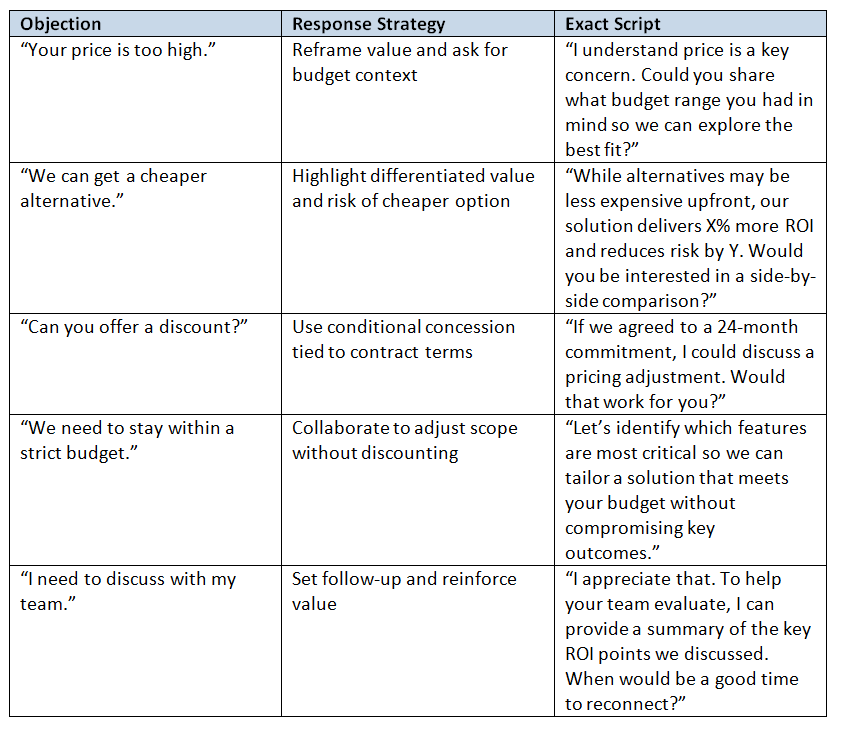
Below is a matrix mapping common price objections to precise, proven word-for-word responses.
Advanced Tactics
Experienced sales professionals can employ advanced pricing tactics beyond basics:
These tactics require finesse and timing but can dramatically improve pricing outcomes.
Scripts and Templates
Below are four ready-to-use scripts for common price conversation scenarios.
“Thank you for your honesty about pricing. To ensure we address your needs, can you share what budget range you had in mind? I want to make sure any solution we propose delivers maximum value within your constraints.”
“I appreciate your interest in a discount. If you can commit to a 24-month contract or increase volume, I can explore adjusted pricing. Does that align with your planning?”
“Before we discuss pricing adjustments, let’s review the value this solution brings. It reduces your operational costs by 15%, which translates to $200K annually—far exceeding the initial investment.”
Subject: Summary of Value and Next Steps
Hi [Client Name],
Thank you for discussing the pricing options today. As promised, attached is a summary outlining the key benefits and ROI metrics of our solution.
I’m confident this aligns well with your goals. Let me know if you would like to schedule a time to address any further questions or finalize next steps.
Best regards,
Frequently Asked Questions
Q1: What is value-based pricing and how does it differ from cost-plus pricing?
Value-based pricing sets prices primarily on the perceived or quantified value delivered to the customer rather than production cost plus margin. Unlike cost-plus, which risks underpricing or overpricing, value-based aligns price with what customers are willing to pay.
Q2: When should sales teams avoid discounting?
Sales teams should avoid discounting when value is clear, alternatives are limited, and the BATNA is strong. Discounting erodes perceived value and can initiate price wars. Instead, focus on communicating differentiated benefits and using conditional concessions.
Q3: How can I calculate the customer’s perceived value?
Conduct detailed discovery to identify pain points, current costs, and desired outcomes. Quantify improvements in revenue, cost savings, risk reduction, or efficiency. Use customer data and benchmarks to convert benefits into dollar terms.
Q4: What psychological biases influence price negotiation?
Anchoring, loss aversion, price-quality heuristic, and the decoy effect strongly influence buyer perception. Understanding these helps you frame pricing conversations to emphasize value and reduce discount pressure.
Q5: How do I handle negotiation when the buyer has a lower budget than my price?
Collaborate to adjust scope, contract terms, or implementation timelines rather than lowering price outright. Use conditional concessions tied to trade-offs and reinforce ROI. Always keep your BATNA in mind.
Conclusion
In today’s hyper-competitive environment, mastering the balance between value-based pricing and price negotiation is essential for protecting margins and sustaining growth. Deep knowledge of pricing psychology, combined with strategic frameworks and disciplined processes, empowers sales professionals to confidently justify premium prices and navigate objections without succumbing to damaging discounting.
By adopting the step-by-step processes, objection handling scripts, and advanced tactics outlined in this definitive guide, you will transform challenging price conversations into opportunities to reinforce value, build trust, and close deals on your terms. Start applying these principles today to win more deals at premium prices—your bottom line will thank you.
Ready to elevate your pricing strategy and negotiation skills? Download our comprehensive pricing playbook and join our upcoming masterclass on value-based selling.
References
1. Kahneman, D., & Tversky, A. (1979). Prospect Theory: An Analysis of Decision under Risk. Econometrica.
2. Ariely, D. (2008). Predictably Irrational: The Hidden Forces That Shape Our Decisions. HarperCollins.
3. Cialdini, R. B. (2006). Influence: The Psychology of Persuasion. Harper Business.
4. Fisher, R., Ury, W., & Patton, B. (1991). Getting to Yes: Negotiating Agreement Without Giving In. Penguin Books.
5. Nagle, T., Hogan, J., & Zale, J. (2016). The Strategy and Tactics of Pricing: A Guide to Growing More Profitably. Routledge.
6. McKinsey & Company. (2020). Value-Based Pricing in B2B: Capturing Growth and Margin. McKinsey Insights.