Virtual International Negotiations: How to Close Deals Across Borders Online

In 2020, a major US-based technology firm attempted to finalize a multi-million dollar joint venture with a South Korean conglomerate through a series of virtual meetings. Despite months of discussions, the deal ultimately collapsed due to misinterpretations rooted in cultural differences around hierarchy and communication style, exacerbated by the lack of in-person cues. The Korean partners perceived the American team’s direct and fast-paced negotiation approach as disrespectful and rushed, while the Americans grew frustrated with what they saw as evasive responses and slow decision-making. This scenario illustrates the high stakes and complexity involved in virtual international negotiations, where technological barriers intersect with deep cultural nuances.
International negotiations are fundamentally more complex than domestic ones due to layers of culture, legal frameworks, language, time zones, and trust-building mechanisms. Unlike face-to-face deals conducted within a shared cultural context, virtual negotiations must bridge differences in communication styles, power distance perceptions, and time orientation without the benefit of physical presence. Many professionals dangerously underestimate these subtleties, leading to stalled talks, contract disputes, or lost opportunities. The challenge is not only mastering negotiation tactics but also developing cultural intelligence and leveraging technology effectively.
This comprehensive guide will equip you with deep insights into cultural frameworks such as Hofstede’s dimensions, Lewis’s behavioral models, and Erin Meyer’s Culture Map. You will learn a step-by-step virtual negotiation strategy tailored for global contexts, expert-level techniques for managing interpreters and hierarchical dynamics online, and exact word-for-word scripts adapted to diverse cultures. Real-world cross-border case studies and practical checklists will empower you to close deals across borders confidently and seamlessly in the virtual realm.
· Table of Contents
· The Foundations of International Negotiation
· Key Frameworks and Cultural Models
· Step-by-Step Strategy for Virtual International Negotiations
· Real-World Case Studies
· Country-Specific Negotiation Insights and Challenge-Specific Tactics
· Advanced Strategies for Managing Culture and Technology
· Scripts and Templates for Virtual Negotiations
· Frequently Asked Questions
· Conclusion
· References
The Foundations of International Negotiation
Negotiating across borders requires more than just transactional skills; it demands a profound understanding of cultural, psychological, and structural factors that shape behavior and decision-making. Unlike domestic negotiations, where shared assumptions often underpin interactions, international negotiations involve navigating complex layers of cultural values, communication styles, legal systems, and relationship norms.
Geert Hofstede’s seminal research identifies six cultural dimensions that influence negotiation: power distance (acceptance of hierarchical inequality), individualism versus collectivism (focus on self vs. group), uncertainty avoidance (tolerance for ambiguity), masculinity versus femininity (competitiveness vs. care orientation), long-term orientation (future vs. short-term focus), and indulgence versus restraint (gratification of desires). For example, high power distance cultures such as Mexico or India will expect clear hierarchical authority in negotiations, while low power distance countries like Sweden encourage egalitarian dialogue.
Richard Lewis categorizes cultures by communication and action preferences into Linear-Active (task-oriented, factual, plan-driven, e.g., Germany, Switzerland), Multi-Active (relationship-oriented, emotional, flexible, e.g., Latin America, Southern Europe), and Reactive (listening-first, respectful, harmony-seeking, e.g., Japan, China). Understanding these types aids negotiators in anticipating interaction styles and managing pacing.
Edward Hall’s concepts of high-context and low-context communication further illuminate differences: high-context cultures (Japan, Arab countries) rely heavily on nonverbal cues and shared context, making implicit communication critical, whereas low-context cultures (USA, Germany) prefer explicit, direct messages. Hall also distinguishes monochronic time cultures, which value punctuality and linear scheduling, from polychronic cultures where multitasking and flexible timeframes prevail.
Erin Meyer’s Culture Map integrates these ideas into eight dimensions relevant for negotiations: communicating (direct vs. indirect), evaluating (negative vs. positive feedback), persuading (principles-first vs. applications-first), leading (egalitarian vs. hierarchical), deciding (consensual vs. top-down), trusting (cognitive vs. affective), disagreeing (confrontational vs. avoids confrontation), and scheduling (linear vs. flexible). These dimensions help negotiators tailor approach, tone, and timing.
Key Frameworks and Cultural Models
To navigate virtual international negotiations effectively, mastering cultural frameworks is essential. Below are three foundational models with a comparative table illustrating their core dimensions across select countries.
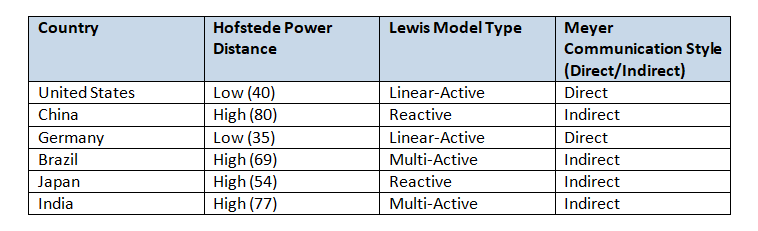
Geert Hofstede’s dimensions provide quantitative insights into cultural values, useful in risk assessment and strategy design. For example, the United States scores low on power distance and high on individualism, favoring egalitarian negotiation and personal achievement. China scores high on power distance and collectivism, indicating respect for hierarchy and group consensus.
Richard Lewis’s typology helps anticipate negotiation style and pacing. Linear-Active negotiators prefer structured agendas and factual argumentation, Multi-Active focus on personal relationships and emotions, while Reactive cultures listen and respond delicately to maintain harmony.
Erin Meyer’s Culture Map sharpens understanding by identifying communication and decision-making preferences. For instance, Germany’s directness can clash with Japan’s indirect communication, necessitating careful adaptation in virtual settings where nonverbal cues are limited.
Step-by-Step Strategy for Virtual International Negotiations
Successful virtual negotiations require a disciplined, culturally informed process. Below is a detailed six-step strategy.
Step 1: Preparation and Cultural Research
Before the first virtual meeting, conduct rigorous cultural due diligence. Utilize Hofstede, Lewis, and Meyer frameworks to create a cultural profile of your counterparts. Identify language proficiency, hierarchy expectations, communication preferences, and decision-making styles. Prepare technology checks to ensure stable connections and familiarity with platforms. Plan agenda flexibility to accommodate polychronic cultures.
Step 2: Opening and Relationship Building
In virtual settings, building trust requires deliberate effort. Begin with extended small talk reflecting cultural norms — e.g., inquire about family in Middle Eastern contexts or business history in Japan. Use video to maximize nonverbal cues, crucial for high-context cultures. Establish rapport early to compensate for lack of physical presence.
Step 3: Exploration and Information Exchange
Encourage open dialogue while respecting communication styles. For Linear-Active cultures, provide clear data and structured questions. For Multi-Active or Reactive cultures, allow narrative and indirect feedback. Use active listening and confirm understanding via paraphrasing. Employ interpreters if language barriers exist.
Step 4: Bargaining and Proposal Framing
Frame offers aligned with cultural values. In collectivist or high power distance contexts, emphasize group benefit and senior approval. In individualist cultures, highlight personal gains and quick decision-making. Avoid confrontational tactics with Reactive cultures; prefer consensus-building. Use pauses tactically in polychronic cultures to allow reflection.
Step 5: Closing the Deal
Summarize agreements clearly in writing, considering legal standards such as the UN Convention on Contracts for the International Sale of Goods (CISG) for cross-border enforceability. Confirm mutual understanding and ensure face-saving language for indirect cultures. Schedule follow-up meetings to affirm commitments.
Step 6: Follow-Up and Relationship Maintenance
Virtual deals demand ongoing relationship management. Send culturally adapted thank-you notes. Use digital collaboration tools to maintain transparency. Monitor compliance and address issues with sensitivity to hierarchical and communication norms.
Real-World Case Studies
Examining specific international deals reveals cultural dynamics and lessons.
US-China Technology Licensing Negotiation (2018)
A US semiconductor company negotiated virtual licensing agreements with Chinese state-owned firms. The Americans’ direct, time-sensitive approach clashed with Chinese emphasis on guanxi (relationship-building) and hierarchical approvals. Progress stalled until the US team engaged senior Chinese officials via WeChat and integrated formal pre-negotiation “nemawashi” consensus-building offline. This hybrid approach restored trust and led to a successful license deal.
EU-UK Brexit Trade Talks (2019-2020)
Virtual negotiations characterized by cultural and political friction. The UK’s preference for direct, adversarial bargaining conflicted with the EU’s consensus-driven, process-oriented style. Time zone coordination and document-heavy exchanges complicated discussions. Incorporating Erin Meyer’s Culture Map, negotiators adapted tone and pacing, emphasizing transparent communication and phased agreements, which helped secure the post-Brexit trade accord.
Japan-US Automotive Partnership (2021)
Japanese and American automakers negotiated a joint venture via virtual platforms during the pandemic. Japanese Reactive style valued harmony and indirect feedback, while Americans sought explicit commitments. Use of professional interpreters and carefully scripted emails helped bridge communication gaps. The Americans adopted a more patient, consensus-driven style aligned with Japanese long-term orientation, culminating in a multibillion-dollar partnership.
Country-Specific Negotiation Insights and Challenge-Specific Tactics
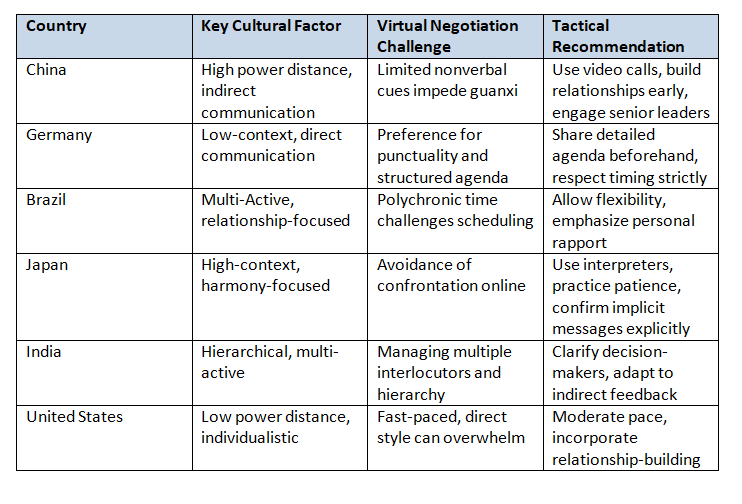
This table summarizes vital cultural and tactical insights for virtual negotiations with key countries.
Advanced Strategies for Managing Culture and Technology
Expert negotiators deploy advanced tactics to overcome virtual barriers:
· Managing interpreters: Brief interpreters thoroughly on agenda and cultural nuances; use consecutive interpretation to ensure accuracy; allow extra time.
· Building guanxi/wasta/wasta: Invest time in informal virtual communications, use local cultural brokers, and demonstrate respect for hierarchy to build social capital.
· Navigating hierarchy: Identify decision-makers early; tailor communication to respect rank; use formal titles and honorifics where culturally appropriate.
· Handling face-saving: Use indirect language to avoid embarrassment; offer compromises gently; acknowledge counterpart’s status publicly in meetings.
· Managing time differently: Schedule meetings respecting time zones and cultural scheduling norms; allow buffer time; be flexible with interruptions in polychronic cultures.
Scripts and Templates for Virtual Negotiations
Below are example scripts adapted to different cultural contexts.
“Good morning, Mr. Tanaka. Thank you for joining today’s meeting. We hope to build a partnership that respects your values and business practices. Please feel free to share your thoughts openly; we are eager to understand your perspective.”
Dear Mr. Silva,
Following our recent discussion, please find attached the detailed proposal outlining key deliverables and timelines. We have designed the schedule to accommodate your team’s preferences. Kindly review and provide feedback by next Friday.
Best regards,
尊敬的李先生,
感谢您之前的说明。为了更好地理解合作条款,烦请您进一步阐述关于付款安排的细节。期待您的回复。
此致
敬礼
Dear Frau Schmidt,
I hope this message finds you well. Kindly requesting an update on the documents we discussed last week. Please let us know if any clarifications are needed.
Warm regards,
Dear Mr. Johnson,
It was a pleasure to discuss the terms of our agreement. We trust this marks the beginning of a fruitful partnership. Please find attached the signed contract for your records. We look forward to our continued cooperation.
Respectfully,
Frequently Asked Questions
A1: Employ professional interpreters familiar with both languages and cultures. Use simple, clear language and avoid idioms. Confirm understanding frequently and utilize follow-up emails summarizing key points.
A2: Use reliable video conferencing platforms with screen sharing (Zoom, Microsoft Teams), digital whiteboards (Miro, MURAL), and secure document-sharing tools (DocuSign, Dropbox). Test technology beforehand to avoid disruptions.
A3: Use scheduling tools (World Time Buddy) to find mutually convenient times. Rotate meeting times to share inconvenience fairly. Provide agendas and materials in advance so participants can prepare asynchronously if needed.
A4: Prioritize video calls over audio-only to capture nonverbal cues. Engage in informal conversations to build rapport. Demonstrate cultural respect by learning basic greetings and customs. Follow through promptly on commitments.
A5: High cultural intelligence enables negotiators to anticipate misunderstandings, adapt communication style, and build stronger relationships, significantly increasing the likelihood of reaching agreements and avoiding conflicts.
Conclusion
Virtual international negotiations present unique challenges and opportunities shaped by cultural complexity and technological mediation. Through mastering foundational cultural frameworks like Hofstede’s dimensions, Lewis’s behavior typologies, and Meyer’s Culture Map, negotiators gain the insight necessary to decode counterpart behaviors and expectations. A structured, stepwise approach combined with advanced tactics—such as managing interpreters and honoring hierarchical sensitivities—maximizes the chance of closing deals successfully.
As global business increasingly shifts online, executives and dealmakers must elevate their cultural intelligence alongside digital proficiency. The scripts, case studies, and tactical recommendations provided here serve as a practical blueprint to navigate the intricacies of virtual international negotiations with confidence and finesse. Embrace these insights to transform cross-border challenges into lasting partnerships.
References
· Hofstede, G. (2001). Culture's Consequences: Comparing Values, Behaviors, Institutions and Organizations Across Nations. Sage Publications.
· Lewis, R. D. (2006). When Cultures Collide: Leading Across Cultures. Nicholas Brealey Publishing.
· Meyer, E. (2014). The Culture Map: Breaking Through the Invisible Boundaries of Global Business. PublicAffairs.
· Hall, E. T. (1976). Beyond Culture. Anchor Books.
· Fisher, R., Ury, W., & Patton, B. (2011). Getting to Yes: Negotiating Agreement Without Giving In. Penguin Books.
· UNCITRAL Model Law on International Commercial Arbitration (1985), United Nations Commission on International Trade Law.