What to Do When a Negotiation Is Stuck: The Definitive Guide for Managers and Negotiators

Imagine a tense boardroom where two multinational corporations are on the brink of a multi-billion-dollar merger. Months of preparation have led to this moment, but now the negotiation has ground to a halt. One side accuses the other of bad faith; emotions flare, voices rise, and the deal that would reshape an industry suddenly teeters on the edge of collapse. This is no ordinary deadlock — it’s a psychological standoff where each party’s identity, interests, and fears collide, threatening to unravel years of work.
Negotiations are won or lost in the early moments of interaction, yet most professionals fail to recognize the invisible psychological forces at play. Daniel Kahneman’s System 1 impulsivity often hijacks rational thought, while emotional flooding and perceived attacks trigger defensive fight-flight-freeze responses. Misreading these cues or responding with aggression only deepens the impasse. Without a strategic approach grounded in behavioral science and practical frameworks, stuck negotiations become entrenched battles instead of opportunities for creative problem-solving.
In this comprehensive guide, you will master actionable techniques and frameworks that top negotiators, diplomats, and sales leaders use to break deadlocks and restore productive dialogue. You will learn how to apply tactical empathy as Chris Voss teaches, leverage William Ury’s “Going to the Balcony” mindset, navigate the Thomas-Kilmann Conflict Model, and deploy exact word-for-word scripts designed to de-escalate and re-engage. With detailed step-by-step processes, real-world case studies, manipulation countermeasures, and advanced psychological tactics, this article equips you to transform negotiation stalemates into breakthroughs.
· Table of Contents
· The Psychology Behind This Challenge
· Key Frameworks and Models for Breaking Deadlocks
· Step-by-Step Process to Get Unstuck
· Real-World Case Studies of Deadlock Resolution
· Recognizing and Countering Manipulative Tactics
· Advanced Psychological and Strategic Techniques
· Scripts and Templates for Difficult Scenarios
· Frequently Asked Questions
· Conclusion and Next Steps
· References
The Psychology Behind This Challenge
Understanding why negotiations get stuck requires delving into the neuroscience and psychology that govern human behavior under stress. One of the core drivers is the **amygdala hijack**, a term popularized by Daniel Goleman, describing how the brain’s emotional center can override rational thought when perceiving threat. This triggers an immediate fight-flight-freeze response, often resulting in aggressive posturing or withdrawal, neither conducive to productive negotiation.
Daniel Kahneman’s dual-process theory of cognition distinguishes between **System 1** — fast, automatic, emotional thinking — and **System 2** — slow, deliberate, analytical thought. When parties feel threatened, System 1 dominates, leading to snap judgments, confirmation bias, and distorted perceptions of the other side’s intentions. This often causes negotiators to escalate conflict instead of seeking common ground.
Chris Voss’s concept of **tactical empathy** emphasizes recognizing and validating the counterpart’s emotions to bypass the amygdala hijack and engage their System 2 thinking. This technique helps reduce emotional flooding — a state where intense feelings impair decision-making, as studied by psychologist John Gottman — and encourages openness.
The **fight-flight-freeze** response is also linked to **social identity theory**, where individuals see threats to their group's status or values as existential. In negotiations involving identity—such as labor disputes, political talks, or cultural clashes—this intensifies rigidity, making compromise psychologically costly and difficult.
By recognizing these psychological mechanisms, negotiators can design interventions that calm emotional reactions, rebuild trust, and shift parties from defensive postures to collaborative problem-solving.
Key Frameworks and Models
Several established frameworks provide structured approaches to analyze conflict and guide negotiators out of deadlocks. Below is a comparison of three prominent models frequently used in high-stakes negotiation settings.
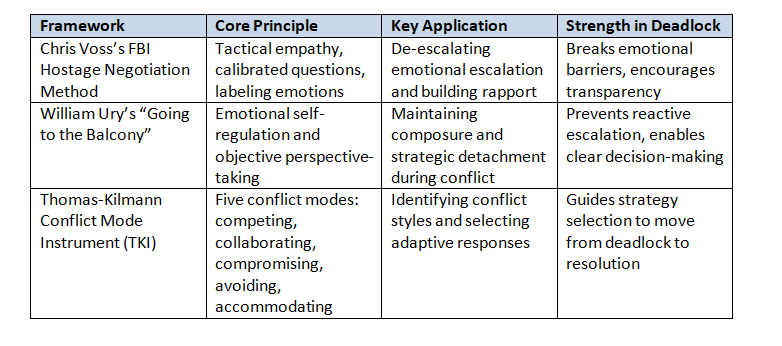
These models complement each other: Voss’s method focuses on emotional intelligence in real-time dialogue, Ury’s promotes mental discipline and perspective, and TKI offers insight into behavioral tendencies that can be shifted to unlock stalemates.
Step-by-Step Process
Effective resolution of a stuck negotiation demands a precise, psychologically informed sequence of actions. Below is a detailed six-step process incorporating the frameworks and psychological principles discussed.
Step 1: Pause and “Go to the Balcony”
When a negotiation starts spiraling, intentionally pause and adopt William Ury’s “Going to the Balcony” mindset. This means stepping back mentally and emotionally from the heated interaction to regain composure and objectivity. Use deep breathing and mental imagery to reduce amygdala activation.
Script: “Let me take a moment to clarify our positions calmly so we can find a path forward.”
Step 2: Identify and Label Emotions
Using Chris Voss’s labeling technique, actively listen for emotional cues, including verbal tone and body language (micro-expressions per Paul Ekman). Verbally acknowledge these feelings without judgment to diffuse defensiveness.
Script: “It seems like this issue is really frustrating for you.”
Step 3: Apply Tactical Empathy
Demonstrate understanding of the other party’s perspective and underlying needs, even if you disagree with their stance. This opens the door to collaborative problem-solving.
Script: “I can see why protecting your team’s interests here matters deeply.”
Step 4: Reframe the Problem and Establish Shared Goals
Shift from positional bargaining to interest-based negotiation by reframing the deadlock as a mutual problem needing joint resolution.
Script: “We both want this deal to succeed — let’s explore options that work for both sides.”
Step 5: Use Calibrated Questions to Encourage Dialogue
Ask open-ended, solution-oriented questions to invite creativity and reveal hidden constraints or priorities.
Script: “How can we adjust the terms to address your key concerns?”
Step 6: Develop Incremental Agreements and Confirm Understanding
Break the deadlock by securing small, concrete agreements that build momentum and trust. Summarize frequently to ensure clarity.
Script: “So we agree to review the pricing model next week and explore alternative payment structures?”
Real-World Case Studies
Analyzing actual negotiations illustrates how these principles and steps play out under pressure.
Case Study 1: The 1993 FBI Hostage Negotiation at the New York Museum
When a gunman took hostages, FBI negotiators applied tactical empathy and labeling to de-escalate tension. By validating the suspect’s emotions (“It sounds like you feel cornered”), they built rapport and avoided violence. The negotiation ended peacefully after hours, showcasing how emotional intelligence breaks deadlocks in life-or-death scenarios.
Case Study 2: The 2018 Disney-Fox Acquisition Negotiations
Midway through talks, disagreements on valuation caused the merger to stall. Disney’s negotiation team used Ury’s “balcony” strategy to prevent reactive escalation during heated calls and applied calibrated questions to uncover Fox’s non-monetary priorities. Incremental agreements on intellectual property rights reopened dialogue and sealed the deal.
Case Study 3: Toxic Client Negotiation in a Global Advertising Contract
A client’s aggressive demands led to a stalemate. The account manager recognized manipulation tactics (see below), responded with tactical empathy to acknowledge frustrations, and reframed the negotiation as a partnership rather than adversarial. This shifted the client’s stance, enabling a constructive resolution.
Recognizing and Countering Tactics
Negotiators often face psychological manipulation and disruptive tactics that exacerbate deadlocks. The table below maps common tactics to their underlying psychological mechanisms and exact counter-responses.
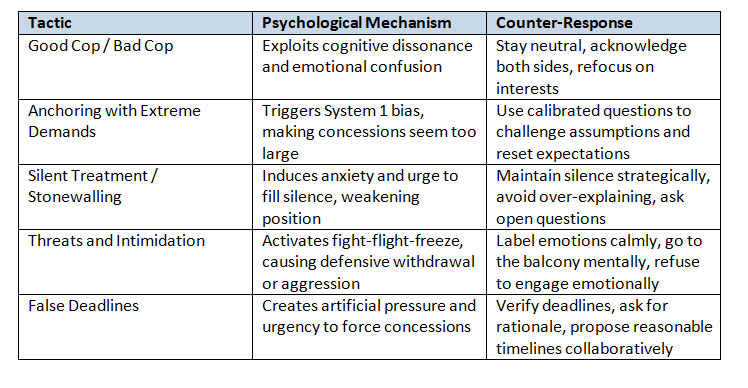
Recognizing these tactics early and responding with precise psychological tools neutralizes manipulation and preserves negotiation integrity.
Advanced Techniques
Experienced negotiators facing entrenched deadlocks can deploy sophisticated methods beyond basic tactics:
· **The “Third Side” Approach (William Ury):** Enlist neutral stakeholders or mediators who represent the broader community interest to shift dynamics and introduce alternative perspectives.
· **Amy Cuddy’s Presence Techniques:** Use power posing and voice modulation to project calm confidence, reducing counterpart intimidation and improving your own stress resilience.
· **Micro-Expression Detection (Paul Ekman):** Spot fleeting emotional leaks that reveal true feelings or concealed concerns, allowing tailor-made empathetic interventions.
· **Moral Framing (Jonathan Haidt):** Recognize moral foundations driving opponent’s rigidity and reframe proposals to align with their core values, increasing acceptance.
· **Reciprocal Concessions with a Twist:** Make carefully calibrated minor concessions paired with requests for proportional reciprocal moves to build fairness and momentum.
These advanced tools require practice and situational awareness but can transform intractable negotiations into opportunities for creative breakthroughs.
Scripts and Templates
Below are exact dialogue scripts designed for common difficult negotiation scenarios. Use these as starting points and adapt to your context.
Script 1: De-escalating Emotional Outburst
“I understand this is a critical issue for you, and I want to make sure we fully address your concerns. Let’s take a moment to clarify what matters most so we can move forward effectively.”
Script 2: Responding to an Extreme Anchor
“That’s a significant figure. Can you help me understand how you arrived at that number? What priorities does it reflect?”
Script 3: Handling Silence or Stonewalling
“I notice it’s quiet on your end. What thoughts are you weighing right now? I want to make sure we don’t miss anything important.”
Script 4: Countering Threats Calmly
“It sounds like you’re feeling frustrated, and I want to work together to find a solution that respects both our interests. Let’s focus on what we can control.”
Script 5: Proposing Incremental Agreement
“To keep progress going, can we agree on resolving this smaller point first and then revisit the larger issue with fresh information?”
Frequently Asked Questions
Q1: What immediate steps should I take if a negotiation suddenly stalls?
A1: Pause and avoid reactive responses. Use Ury’s “balcony” technique to regulate your emotions, identify the root cause of the stall, and apply tactical empathy to reestablish connection.
Q2: How do I prevent my own biases from worsening deadlocks?
A2: Be aware of System 1 biases (confirmation bias, anchoring). Slow down decision-making, seek objective data, and solicit outside perspectives to engage System 2 analytical thinking.
Q3: Can mediation help when negotiations are stuck?
A3: Yes, third-party mediation can provide neutral facilitation, reframing, and accountability that help parties move beyond entrenched positions, especially when emotional or identity conflicts are involved.
Q4: How do I handle a counterpart using manipulative tactics?
A4: Recognize the tactic early (e.g., threats, silence, extreme anchoring), label their behavior calmly, refuse to escalate emotionally, and redirect the conversation toward interests and mutual goals.
Q5: What psychological signals indicate a negotiation is about to break through a deadlock?
A5: Signs include a shift from reactive to reflective language, increased use of collaborative framing (“we” vs. “I”), willingness to explore options, and reduced emotional intensity or defensiveness.
Conclusion
Navigating a stuck negotiation is as much an art as a science, requiring mastery of psychological insight, strategic frameworks, and precise communication. Recognizing the biological impulses that trigger defensive reactions enables you to intervene early and steer conversations away from escalation. Applying proven models like Voss’s tactical empathy and Ury’s emotional regulation techniques empowers you to rebuild trust and open channels of creative problem-solving. By combining these with tactical questioning, incremental agreements, and awareness of manipulation tactics, you transform deadlocks into opportunities for durable agreements.
The stakes in high-conflict negotiations—whether in corporate boardrooms, client relationships, or diplomatic arenas—demand that you move beyond instinctive reactions to a disciplined, psychologically informed approach. Start integrating these frameworks and scripts today to break through your toughest impasses. For personalized coaching and advanced negotiation training tailored to your industry, contact our expert team and turn stuck negotiations into your greatest successes.
References
1. Kahneman, D. (2011). *Thinking, Fast and Slow*. Farrar, Straus and Giroux.
2. Voss, C., & Tenenbaum, T. (2016). *Never Split the Difference: Negotiating As If Your Life Depended On It*. Harper Business.
3. Ury, W. (1993). *Getting Past No: Negotiating in Difficult Situations*. Bantam Books.
4. Cialdini, R. B. (2006). *Influence: The Psychology of Persuasion*. Harper Business.
5. Ekman, P. (2009). *Telling Lies: Clues to Deceit in the Marketplace, Politics, and Marriage*. W. W. Norton & Company.
6. Gottman, J. M. (1994). What Predicts Divorce? The Relationship Between Marital Processes and Marital Outcomes. *Journal of Family Psychology*, 7(2), 165–173.
7. Haidt, J. (2012). *The Righteous Mind: Why Good People Are Divided by Politics and Religion*. Pantheon Books.