
When to Give a Discount — and When Absolutely Not To: The Definitive Guide for Sales Professionals

Imagine a senior account executive at a SaaS company on the brink of losing a multimillion-dollar deal. The buyer suddenly pushes back, saying, "Your price is too high; can you offer a discount?" The salesperson feels the pressure mounting. Discounting could save the deal—but at what cost? Should they concede, or stand firm and risk losing the client? This scenario represents a critical juncture faced daily by sales professionals worldwide.
Discounting is one of the most misunderstood and misapplied tactics in sales. Studies show that over 50% of B2B deals involve some form of discounting, yet many companies fail to track or manage the true cost of these price cuts. Unnecessary discounting erodes margins, damages brand perception, and trains buyers to expect lower prices. More than just a number game, discounting taps into deep psychological dynamics influencing buyer behavior, including price perception, anchoring, and the elusive perception of value.
This comprehensive guide will equip you with a scientifically grounded understanding of the psychology behind pricing decisions and discounting. You will master proven frameworks to evaluate when discounting creates value — and when it destroys it. You will gain a step-by-step process to handle discount requests confidently without leaving money on the table. Real-world examples from Apple, Salesforce, and McKinsey will illuminate best practices. This article also provides exact scripts, advanced tactics, and objection-handling matrices to ensure you never give a discount unnecessarily again.
· Table of Contents
· The Psychology of Price: Behavioral Economics Behind Price Perception
· Key Frameworks for Discount Decision-Making
· Step-by-Step Process to Manage Discount Requests
· Real-World Examples: Apple, Salesforce, McKinsey
· Objection Handling: Price Pushback Scripts
· Advanced Tactics to Protect Margins
· Scripts and Templates: Ready-to-Use Dialogues
· Frequently Asked Questions
· Conclusion and Call to Action
· References
The Psychology of Price
Understanding when to discount begins with understanding how buyers perceive price. Behavioral economics and psychology reveal that price is far from a rational calculation; it is a complex signal shaped by cognitive biases, heuristics, and social context.
Kahneman and Tversky’s Prospect Theory (1979) showed that humans experience losses more acutely than gains—leading buyers to view discounts not just as a gain but as a relief from a perceived loss. This loss aversion means discounting can create a powerful emotional pull—but also sets expectations buyers will cling to in future negotiations.
The Anchoring Effect, researched extensively by Dan Ariely (Predictably Irrational, 2008), demonstrates how the initial price presented acts as a mental anchor shaping all subsequent price evaluations. Discounting shifts this anchor downward, potentially eroding the product’s perceived value. For example, Amazon’s occasional lightning deals create temporary anchors making regular prices seem higher by comparison.
The Price-Quality Heuristic is a subconscious shortcut where buyers associate higher prices with higher quality. This heuristic explains why luxury brands like Apple or Rolex rarely discount. Their premium pricing signals exclusivity and superior performance—discounts would undermine their brand equity.
Ariely’s work also highlights the Decoy Effect, where introducing a third option can make another product seem more attractive. Strategic pricing and discounting can leverage this, but indiscriminate discounting destroys differentiation and confuses buyers.
Veblen Goods—named after economist Thorstein Veblen—are luxury products whose demand increases as price increases, precisely because the high price confers status. Discounting Veblen goods runs counter to their value proposition.
In sum, the psychology of price teaches that discounting is not just about dollars off—it reshapes buyer perceptions, expectations, and the very meaning attached to your product or service. Done correctly, discounts can create value; done poorly, they devalue your entire offering.
Key Frameworks
To decide when to give a discount and when to hold firm, several established frameworks provide a structured approach. Here are three critical ones:
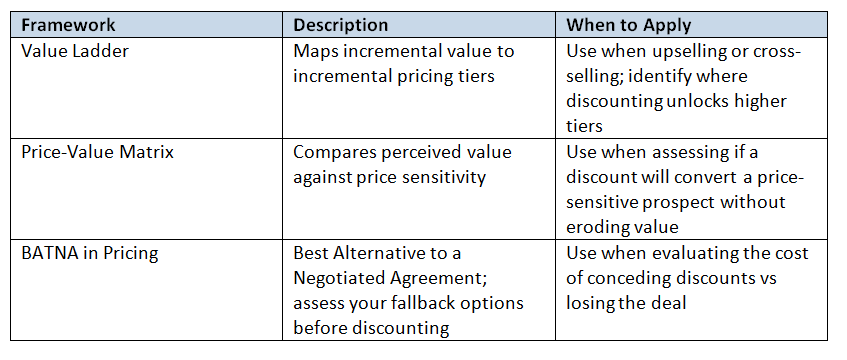
These frameworks enable sales professionals to balance buyer value, competitive positioning, and margin protection before offering discounts.
Step-by-Step Process
Mastering discount decisions requires a disciplined, repeatable process. Follow these six steps:
Step 1: Qualify the Discount Request
Ask probing questions to understand why the buyer wants a discount. Is it budget constraints, competitor pressure, or perceived lack of value? Use open-ended questions such as:
"Can you share more about what’s driving your concern on price?"
Step 2: Reaffirm Value
Before discussing price, reiterate the unique value your solution delivers. Frame benefits in business outcomes, ROI, and risk mitigation.
"For context, our platform reduces your operational costs by 20% annually, which more than offsets the list price."
Step 3: Assess Your BATNA
Evaluate your alternatives if you refuse the discount. Can you walk away, propose other concessions, or adjust terms without lowering price?
"If a discount isn’t possible, are there specific contract terms or payment options that would help?"
Step 4: Explore Creative Alternatives
Consider non-price concessions that add value without cutting price, such as training, extended support, or pilot programs.
"Instead of a discount, we could include an additional training session at no cost."
Step 5: Calculate Margin Impact
Quantify how much margin a discount will cost and whether it is justified by deal size, lifetime value, or strategic importance.
"A 10% discount reduces our margin by $50k; let’s ensure that investment aligns with your long-term needs."
Step 6: Make the Decision and Communicate Firmly
If discounting is warranted, structure it with clear terms (one-time, conditional). If not, firmly but respectfully decline using scripts that reinforce value.
"Given the value and our pricing structure, we’re unable to offer a discount at this time. Let’s explore how we can maximize ROI within the current scope."
Real-World Examples
Apple Inc.: The Power of Premium Pricing
Apple rarely discounts its flagship products. Their strategy leverages the price-quality heuristic and Veblen effect, signaling exclusivity and innovation. When Apple occasionally offers discounts (e.g., education pricing), it is tightly controlled and targeted. This preserves brand equity and allows Apple to maintain industry-leading margins exceeding 38%.
Salesforce: Strategic Discounting in Enterprise Sales
Salesforce employs value-based pricing but uses structured discounting during contract negotiations depending on deal size and strategic fit. Discount requests trigger a formal review process balancing margin impact against customer lifetime value. Salesforce also uses BATNA analysis rigorously—knowing when to stand firm or walk away has been critical to their sustained growth.
McKinsey & Company: No-Discount Culture in Professional Services
As a premier management consultancy, McKinsey famously avoids discounting fees. Their pricing reflects the high-value, bespoke nature of their services. Instead of discounts, McKinsey offers scope adjustments or phased engagements. This maintains perceived value and reinforces their premium market position.
Objection Handling
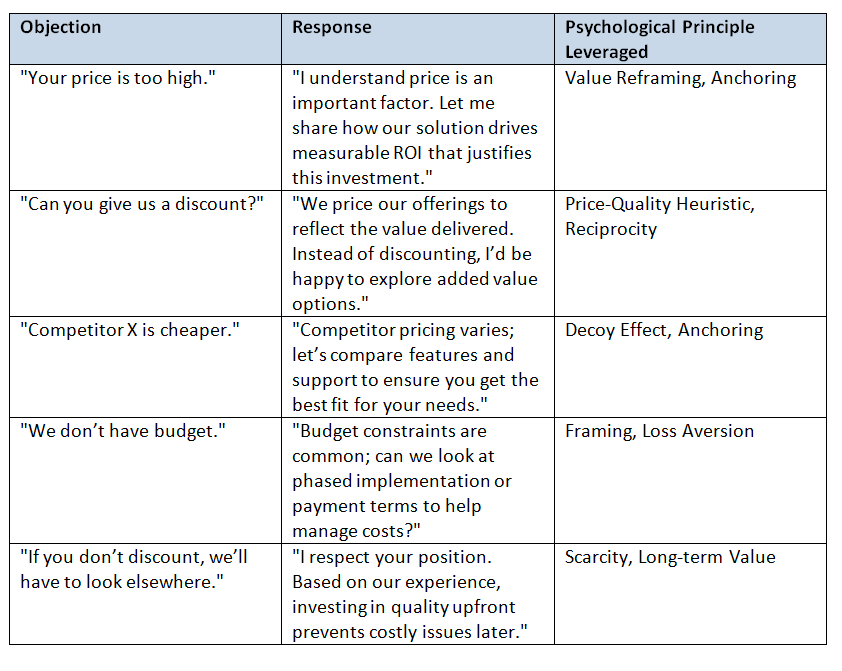
Below is a table mapping common price objections to exact responses proven effective in maintaining pricing integrity.
Advanced Tactics
For seasoned sales pros, these expert techniques help protect margins while closing deals:
· Tiered Discounting: Offer escalating discounts tied to volume or contract length to incentivize commitment without arbitrary cuts.
· Conditional Discounts: Make discounts contingent on upfront payment, referral commitments, or expedited contract signing.
· Bundling and Packaging: Create premium bundles that increase perceived value, making discounts less necessary.
· Time-Limited Offers: Use scarcity principles to prompt decisions without permanently lowering price expectations.
· Internal Discount Approval Processes: Implement multi-level review to prevent unauthorized discounting and maintain pricing discipline.
· Leveraging Testimonials and Case Studies: Reinforce value to counteract price objections psychologically.
Scripts and Templates
Use these exact word-for-word templates to handle discount discussions confidently:
Script 1: Refusing a Discount Politely
"Thank you for your interest in working with us. Our pricing reflects the significant value we deliver, and we’re confident it will meet your needs. While we’re unable to offer a discount at this time, I’m happy to explore other ways to maximize your return on investment."
Script 2: Proposing Added Value Instead of Discount
"I understand your budget concerns. Rather than reducing price, we can include additional onboarding support and training sessions at no extra cost to ensure faster time-to-value."
Script 3: Anchoring Before Price Discussion
"Before discussing price, let me highlight how our solution reduces your operational costs by 20% annually, delivering ROI well beyond the initial investment."
Email Template: Responding to a Discount Request
Subject: Re: Pricing Discussion
Hi [Name],
Thank you for your candid feedback on pricing. Our prices are set to reflect the value and outcomes we deliver. While we don’t typically offer discounts, I’d be glad to discuss alternative options such as extended payment terms or additional services that could fit your needs.
Looking forward to your thoughts.
Best,
Frequently Asked Questions
1. When is it appropriate to offer a discount during a sales negotiation?
Discounts should be considered only after fully qualifying the buyer’s needs, reaffirming value, and assessing your alternative options (BATNA). They are appropriate when discounts unlock higher deal sizes, accelerate close timelines, or when strategic long-term value justifies temporary margin sacrifice.
2. How can I avoid training customers to always ask for discounts?
Avoid habitual discounting by setting clear pricing policies, offering non-price concessions, and communicating the value of your product consistently. Use conditional discounts strategically rather than as a default response.
3. What psychological effects do discounts have on buyers?
Discounts trigger loss aversion relief but can also anchor price expectations downward and reduce perceived quality. They can create urgency if time-limited but may decrease perceived exclusivity in premium brands.
4. How do I calculate the true cost of a discount?
Calculate the margin lost per deal from the discount, then factor in potential long-term impacts like lower renewal rates or brand dilution. Compare against expected deal lifetime value to determine if discounting is justified.
5. What are effective tactics for handling “price is too high” objections without discounting?
Use value reframing by highlighting ROI and outcomes, leverage social proof and testimonials, offer alternative payment or contract terms, and explore added-value options instead of price cuts.
Conclusion
Discounting is a double-edged sword. When wielded correctly, it can facilitate deals that create long-term value and deepen customer relationships. When used indiscriminately, it erodes margins, harms brand perception, and conditions buyers to expect less. Understanding the deep psychology behind price perception, applying structured frameworks, and mastering proven objection-handling scripts will empower you to give discounts only when they truly move the needle.
As a sales professional or business owner, your pricing discipline is a strategic asset. Implement the step-by-step processes and advanced tactics shared here starting today to protect your margins and elevate your deal outcomes. To deepen your expertise further, explore our additional resources and training programs designed to sharpen your negotiation skills and maximize revenue.
Take control of your price negotiations — your bottom line and brand equity depend on it.
References
· Kahneman, D., & Tversky, A. (1979). Prospect Theory: An Analysis of Decision under Risk. Econometrica.
· Ariely, D. (2008). Predictably Irrational: The Hidden Forces That Shape Our Decisions. HarperCollins.
· Cialdini, R. B. (2007). Influence: The Psychology of Persuasion. Harper Business.
· Nagle, T., Hogan, J., & Zale, J. (2016). The Strategy and Tactics of Pricing. Routledge.
· HBR Article: "How to Fight a Price War" by Akshay R. Rao, Mark E. Bergen, and Scott Davis. Harvard Business Review, 2000.
· Veblen, T. (1899). The Theory of the Leisure Class. Macmillan.