ZOPA Strategy in Practice: Finding the Zone of Possible Agreement

Imagine a high-stakes merger negotiation between two multinational corporations where billions of dollars are on the line. Each side enters the room with sharply contrasting price expectations—yet the deal hinges on discovering a common ground that satisfies both parties. Without identifying this elusive overlap, known as the Zone of Possible Agreement (ZOPA), the negotiation collapses, costing millions in lost opportunities and shareholder value. This scenario is not hypothetical; it represents the real-world tension that defines the art and science of successful negotiation.
In today’s hypercompetitive business landscape, the ability to accurately identify and expand the ZOPA is strategically critical. Negotiators must navigate complex, multi-dimensional deals where interests are often concealed, and power dynamics shift rapidly. Mastering ZOPA strategy is no longer optional—it is a core competence that determines whether organizations achieve collaborative success or costly impasses.
This comprehensive guide will equip you with a deep understanding of the theory and psychology behind ZOPA, introduce you to essential frameworks, walk you through a detailed step-by-step process, and share high-impact real-world case studies. You will also learn to sidestep common pitfalls, apply advanced tactics, and use ready-to-deploy negotiation scripts. By the end, you will confidently find and leverage the Zone of Possible Agreement to drive deals that maximize value for all parties.
· Table of Contents
- The Strategic Foundation
- Key Frameworks and Models
- Step-by-Step Process for Identifying and Expanding ZOPA
- Real-World Case Studies
- Common Pitfalls and How to Avoid Them
- Advanced Tactics for Experienced Negotiators
- Scripts and Templates for Effective Negotiation
- Frequently Asked Questions
- Conclusion
- References
The Strategic Foundation
Understanding the Zone of Possible Agreement (ZOPA) requires grasping its psychological underpinnings and strategic implications. The term was popularized by Fisher and Ury in their seminal work "Getting to Yes" (1981), defining ZOPA as the bargaining range where two parties’ minimum and maximum acceptable terms overlap. If the seller’s lowest acceptable price is below the buyer’s highest offer, a deal is possible within that zone.
The psychology behind ZOPA is deeply rooted in behavioral economics and social influence. Kahneman and Tversky’s (1979) research on loss aversion explains why negotiators often perceive offers relative to their reference points, not absolute values. This bias can cause parties to reject beneficial agreements if they perceive losses relative to their expectations rather than potential gains within the ZOPA.
Robert Cialdini’s principles of influence (2006) also intersect with ZOPA strategy. Reciprocity, authority, and commitment can expand or contract the perceived zone by altering trust and willingness to concede. For instance, demonstrating authority or fairness can encourage a counterpart to widen their acceptable range.
Shell’s "Bargaining for Advantage" (2006) emphasizes preparation and understanding one’s Best Alternative to a Negotiated Agreement (BATNA). A strong BATNA shifts the ZOPA in your favor by increasing your minimum acceptable terms, thereby providing leverage. Malhotra and Bazerman’s "Negotiation Genius" (2007) further stress the role of integrative bargaining—identifying shared interests to expand ZOPA beyond fixed pie assumptions.
In summary, ZOPA strategy stands at the intersection of cognitive biases, influence tactics, and rational preparation. Mastering it requires integrating psychological insight with analytical rigor and tactical flexibility.
Key Frameworks and Models
Several frameworks help negotiators identify and operate within the ZOPA effectively. Three of the most influential are:
1. BATNA (Best Alternative to a Negotiated Agreement) – Fisher & Ury
2. ZOPA Identification Model – Shell
3. MESO (Multiple Equivalent Simultaneous Offers) – Lax & Sebenius
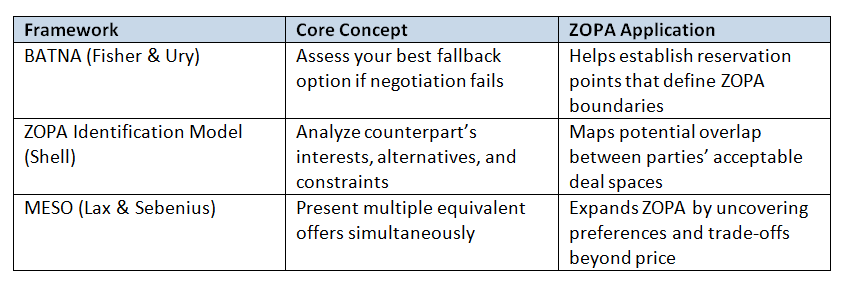
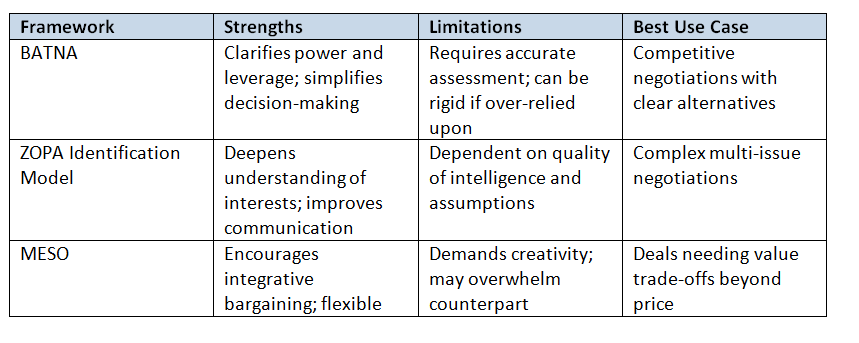
Each framework offers a unique lens. BATNA sets the floor and ceiling of acceptable outcomes by quantifying alternatives. Shell’s model provides a structured way to research and infer the other party’s limits, essential for locating the ZOPA. MESO, a more tactical approach, helps create value by offering options that differ in attributes but hold equal value to you, encouraging the counterpart to reveal their priorities and stretch the zone of agreement.
Step-by-Step Process for Identifying and Expanding ZOPA
Step 1: Conduct Thorough Preparation and BATNA Analysis
Begin by mapping your BATNA—know your alternatives if the deal falls through. Research your counterpart’s BATNA as well. Use public data, market intelligence, and past deal history. This sets your reservation price (minimum or maximum acceptable outcome), effectively defining your side of the ZOPA.
Step 2: Research and Profile the Counterpart
Gather detailed information about the other party’s needs, constraints, cultural context, and negotiation style. Understanding their interests and priorities allows you to infer their reservation points and potential overlap with yours.
Step 3: Define Your Reservation Price and Target Price
Your reservation price is the lowest (or highest) you are willing to accept. Your target price is your aspirational goal. Knowing both allows you to operate within ZOPA consciously and avoid premature concessions or deadlocks.
Step 4: Open with Anchors that Signal Your Position
Use anchoring strategically by offering an initial proposal that sets expectations favorably while remaining credible. Anchors influence perception of fair value and can nudge the ZOPA boundaries in your direction.
Step 5: Engage in Information Exchange and Offer Multiple Equivalent Simultaneous Offers (MESOs)
Share information selectively to reveal interests and priorities. Present MESOs to test which issues matter most to your counterpart, uncover latent value, and expand the ZOPA beyond simple price terms.
Step 6: Manage Concessions and Look for Integrative Opportunities
Track concessions carefully to maintain reciprocity and avoid eroding your leverage. Focus on creating win-win scenarios by trading across issues (e.g., delivery terms for price), enlarging the bargaining zone.
Step 7: Confirm the Overlap and Close the Deal
Once the overlap is identified and maximized, summarize agreed points and confirm mutual gains. Use clear language to solidify commitment and formalize the agreement.
Real-World Case Studies
Case Study 1: Apple vs Samsung Patent Licensing Negotiations
In the intense patent disputes between Apple and Samsung, both companies recognized the high cost of prolonged litigation. Their ZOPA emerged around cross-licensing agreements. By understanding each other’s BATNA—Samsung’s threat of lost market share and Apple’s risk of injunctions—they identified a pricing and licensing zone that allowed mutually beneficial settlements. Key lesson: Even adversarial relationships can find ZOPA through realistic assessment of alternatives and mutual interests.
Case Study 2: Amazon’s Procurement Negotiations with Suppliers
Amazon’s procurement teams use MESO strategies to negotiate with suppliers by presenting multiple package options involving price, volume, and delivery terms. This approach reveals supplier preferences and expands the ZOPA beyond price alone, enabling agreements that optimize cost and supply chain reliability. Key lesson: Multiplying dimensions of negotiation helps discover hidden value and broadens the zone of agreement.
Case Study 3: IBM’s Enterprise Software Licensing Deals
IBM’s enterprise sales rely heavily on precise ZOPA identification through rigorous upfront research on customer budget constraints and IT priorities. Negotiators use anchoring combined with integrative bargaining (e.g., bundling support services) to maximize deal size within the ZOPA. Key lesson: Advanced preparation and multi-issue trade-offs enabled IBM to consistently close complex deals.
Common Pitfalls and How to Avoid Them
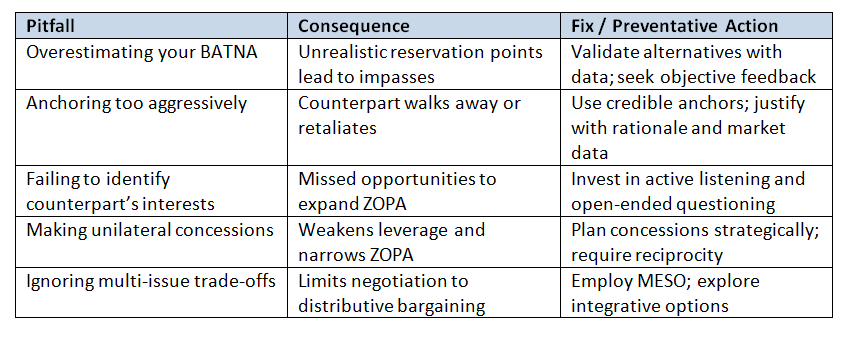
Negotiators frequently stumble into traps that shrink or obscure the ZOPA, causing missed deals or suboptimal outcomes.
Advanced Tactics for Experienced Negotiators
- Leverage “Bracketing”: Deliberately propose offers outside your reservation price to psychologically reset counterpart’s expectations and shift ZOPA boundaries.
- Use “Foot-in-the-Door” Technique: Secure small initial agreements on non-price issues to build momentum and trust before tackling major price terms.
- Apply “ZOPA Expansion” via Third-Party Interests: Introduce shared external goals or regulatory constraints to create additional bargaining room.
- Employ “Silence and Patience”: Strategic pauses after offers can pressure counterparts into revealing more about their reservation points.
- Integrate “Contingent Contracts”: Form agreements that hinge on future events or performance metrics to bridge gaps in current ZOPA.
Scripts and Templates for Effective Negotiation
Example Script for Opening the Negotiation:
“You and I both know that finding common ground is essential for us to move forward. Based on my understanding of your objectives, I believe there is a range where our interests overlap. I’d like to propose a starting point at [anchor figure], which reflects both market realities and our mutual goals. How does that align with your expectations?”
MESO Template Example:
“We have prepared three options that we believe could work well for both parties:
Option A: Price at $X with delivery in 30 days
Option B: Price at $X+5% with delivery in 15 days and extended support
Option C: Price at $X-5% with longer payment terms
Could you share which option best fits your priorities?”
Concession Management Script:
“I appreciate your flexibility on the delivery schedule. In exchange, we would need to maintain the price as previously discussed to ensure feasibility. Does that sound reasonable?”
Frequently Asked Questions
Q1: How do I know if a ZOPA exists before entering negotiations?
A1: Conduct thorough BATNA analysis for both parties and research market conditions. If your reservation price is lower than the counterpart’s, a ZOPA likely exists.
Q2: What if the ZOPA is very narrow or non-existent?
A2: Explore integrative bargaining to add value beyond price or consider alternative deal structures such as contingent contracts to create a new ZOPA.
Q3: How can I prevent the other party from misrepresenting their reservation price?
A3: Use indirect questioning, triangulate information from multiple sources, and employ MESO offers to elicit true preferences.
Q4: Can ZOPA shift during negotiations?
A4: Yes, as parties exchange information and reassess alternatives, the ZOPA can expand or contract dynamically.
Q5: How does cultural context affect ZOPA identification?
A5: Cultural norms influence communication style, risk tolerance, and concession behavior, which impact how reservation prices and interests are presented.
Conclusion
Mastering the Zone of Possible Agreement (ZOPA) is essential for any negotiator seeking to transform conflict into collaboration and maximize deal value. By grounding your approach in rigorous preparation, psychological insight, and proven frameworks, you position yourself to identify the real bargaining zone with confidence. Applying advanced tactics and avoiding common pitfalls further ensures you not only find the ZOPA but effectively expand it to create win-win outcomes.
This guide has equipped you with the strategic foundations, practical processes, and actionable tools to elevate your negotiation performance. Embrace the challenge of ZOPA strategy in your next negotiation and unlock value previously hidden in plain sight. Begin by assessing your BATNA today, and design your approach to discover and harness the Zone of Possible Agreement.
References
- Fisher, R., Ury, W. (1981). Getting to Yes: Negotiating Agreement Without Giving In. Penguin Books.
- Kahneman, D., Tversky, A. (1979). Prospect Theory: An Analysis of Decision under Risk. Econometrica.
- Cialdini, R. B. (2006). Influence: The Psychology of Persuasion. Harper Business.
- Shell, G. R. (2006). Bargaining for Advantage: Negotiation Strategies for Reasonable People. Penguin Books.
- Malhotra, D., Bazerman, M. H. (2007). Negotiation Genius: How to Overcome Obstacles and Achieve Brilliant Results at the Bargaining Table and Beyond. Bantam Books.
- Lax, D. A., Sebenius, J. K. (1986). The Manager as Negotiator: Bargaining for Cooperation and Competitive Gain. Free Press.